
Forums › General Discussion › aft bilge question
- This topic has 8 replies, 5 voices, and was last updated 16 years, 11 months ago by
petedd.
-
AuthorPosts
-
-
November 16, 2009 at 2:10 pm #67787
 RichCarterParticipant
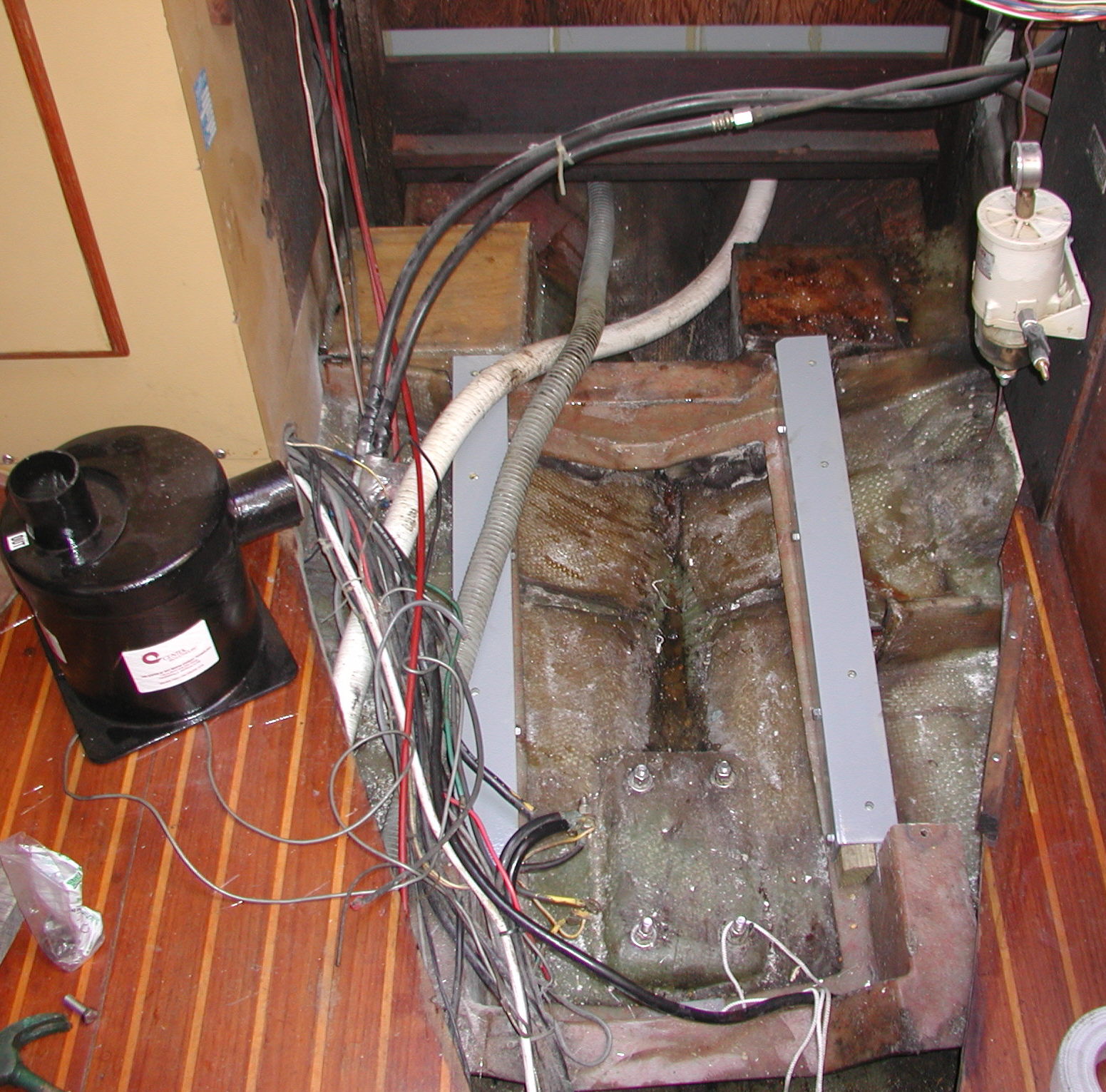
I’ve since cut out most of my engine pan as part of a repower. The engine pan was open at the bottom and had a place for water to pool behind the strut mount and behind the pan. Here’s a photo of the old pan with modified side pieces to mount my new engine.
http://www.richardcarter.net/boat/pix/engPan.JPG
There was a small space under the aft section of the pan that allowed some water to escape under the engine, but a lot of water still pooled under there. After taking this photo I cut out the back of the pan. It simply isn’t needed and interfered with the new engine.
After repowering, I still put oilsorb sheets under the engine but they come out mostly clean at the end of the season. The old W60 was a nice engine but like most British engines it leaked like a sieve.
Regards
Rich
Original Message
<.. snip>Post generated from Pearson424 Forum using Mail2Forum
-
November 16, 2009 at 3:04 pm #74298
petedd
ParticipantSpeaking of British engines… did you know that British engines STILL
don’t have microprocessors (computers) controlling them? Reason: the
Brits have not yet figured out how to make a computer leak oil…And yes, I have been studying your photos. Thanks.
I am thinking of fashioning a separate drip pan for the engine and
allowing the aft water to pass under it to the main bilge. I like to
hat the oilsorb sheet stay dry (from water and oil…) To me that is
the sign of a well-maintained engine space.Pete
wrote:
Quote:I’ve since cut out most of my engine pan as part of a repower. The
engine pan was open at the bottom and had a place for water to pool
behind the strut mount and behind the pan. Here’s a photo of the old
pan with modified side pieces to mount my new engine.http://www.richardcarter.net/boat/pix/engPan.JPG
There was a small space under the aft section of the pan that allowed
some water to escape under the engine, but a lot of water still pooled
under there. After taking this photo I cut out the back of the pan.
It simply isn’t needed and interfered with the new engine.After repowering, I still put oilsorb sheets under the engine but they
come out mostly clean at the end of the season. The old W60 was a
nice engine but like most British engines it leaked like a sieve.Regards
Rich
Original Message
<.. snip>Post generated from Pearson424 Forum using Mail2Forum
-
November 16, 2009 at 3:04 pm #74299Participant
Speaking of British engines… did you know that British engines STILL
don’t have microprocessors (computers) controlling them? Reason: the
Brits have not yet figured out how to make a computer leak oil…And yes, I have been studying your photos. Thanks.
I am thinking of fashioning a separate drip pan for the engine and
allowing the aft water to pass under it to the main bilge. I like to
hat the oilsorb sheet stay dry (from water and oil…) To me that is
the sign of a well-maintained engine space.Pete
wrote:
Quote:I’ve since cut out most of my engine pan as part of a repower. The
engine pan was open at the bottom and had a place for water to pool
behind the strut mount and behind the pan. Here’s a photo of the old
pan with modified side pieces to mount my new engine.http://www.richardcarter.net/boat/pix/engPan.JPG
There was a small space under the aft section of the pan that allowed
some water to escape under the engine, but a lot of water still pooled
under there. After taking this photo I cut out the back of the pan.
It simply isn’t needed and interfered with the new engine.After repowering, I still put oilsorb sheets under the engine but they
come out mostly clean at the end of the season. The old W60 was a
nice engine but like most British engines it leaked like a sieve.Regards
Rich
Original Message
<.. snip>Post generated from Pearson424 Forum using Mail2Forum
-
November 16, 2009 at 4:09 pm #74301
 john stevensonParticipant
Pete,
I thought one of my repower pictures would show the water passage under the engine pan, but I guess I never took a picture from behind the engine pan. As Rich said it is not a big passage. I know when the Westerbecke was pulled there was a ton of dirt and debris around the passage. Water still got through, but it did pool up behind the engine pan.
If you say you don't have a passage under the pan, have you checked to see if it is just covered by 25 years of crud? It really shouldn't accumulate water under the engine unless you have a gusher, but then your pan may not be anything like the one I had on hull #2. Again I never had water accumulate under the engine (other than engine liquids) with a persistent rudder post leak for over a year before the engine pan was re-built and re-glassed.On Mon, Nov 16, 2009 at 10:03 AM, Pete Dubler < ([email][/email])> wrote:
Quote:Speaking of British engines… did you know that British engines STILL don't have microprocessors (computers) controlling them? Reason: the Brits have not yet figured out how to make a computer leak oil…And yes, I have been studying your photos. Thanks.
I am thinking of fashioning a separate drip pan for the engine and allowing the aft water to pass under it to the main bilge. I like to hat the oilsorb sheet stay dry (from water and oil…) To me that is the sign of a well-maintained engine space.
Pete
Quote:I've since cut out most of my engine pan as part of a repower. The engine pan was open at the bottom and had a place for water to pool behind the strut mount and behind the pan. Here's a photo of the old pan with modified side pieces to mount my new engine.http://www.richardcarter.net/boat/pix/engPan.JPG
There was a small space under the aft section of the pan that allowed some water to escape under the engine, but a lot of water still pooled under there. After taking this photo I cut out the back of the pan. It simply isn't needed and interfered with the new engine.
After repowering, I still put oilsorb sheets under the engine but they come out mostly clean at the end of the season. The old W60 was a nice engine but like most British engines it leaked like a sieve.
Regards
Rich
Original Message
<.. snip>Post generated from Pearson424 Forum using Mail2Forum
-
November 16, 2009 at 6:13 pm #74305
Anonymous
On our boat, hull #206 (or is it 203), there are holes in the bvrace that crosses twarthwise cross “pan” under the engine. There are holes which I peiodically have to clean out, usually with my fingers.
Norris Larson on Easy Reach
— On Mon, 11/16/09, John Stevenson <> wrote:
Quote:<.. snip>Post generated from Pearson424 Forum using Mail2Forum
-
November 16, 2009 at 11:52 pm #74307
sumocean
ParticipantPete
Rather than try to fit a pan under the new engine I built a dam between the stringers on the forward end of the compartment. It is high enough to trap an oil spill but not high enough to wet the engine if it fills with water. I have to sponge it out when I have a leak at the back of the boat. I haven’t had to do that in a while. The leak that I had a time figuring out was the hinges on the sail lockers. All of them were leaking a little and I would have to sponge it out after a rain. The great thing about a new engine is all that is in there is water. The pan is coated with pigmented epoxy so it can be cleaned easily.
Linus
<.. snip>
Post generated from Pearson424 Forum using Mail2Forum
-
November 17, 2009 at 3:48 am #74308Participant
thanks Linus
Linus Martinez wrote:
Quote:PeteRather than try to fit a pan under the new engine I built a dam
between the stringers on the forward end of the compartment. It is
high enough to trap an oil spill but not high enough to wet the engine
if it fills with water. I have to sponge it out when I have a leak at
the back of the boat. I haven’t had to do that in a while. The leak
that I had a time figuring out was the hinges on the sail lockers.
All of them were leaking a little and I would have to sponge it out
after a rain. The great thing about a new engine is all that is in
there is water. The pan is coated with pigmented epoxy so it can be
cleaned easily.Linus
*<.. snip>
Post generated from Pearson424 Forum using Mail2Forum
-
November 17, 2009 at 3:49 am #74309Participant
Thanks Norris. Perhaps mine is plugged up as well. Still think I
should have an isolated drip pan under the engine (but let the aft water
pass to the main bilge)norris larson wrote:
Quote:On our boat, hull #206 (or is it 203), there are holes in the bvrace
that crosses twarthwise cross “pan” under the engine. There are holes
which I peiodically have to clean out, usually with my fingers.Norris Larson on /Easy Reach/
— On *Mon, 11/16/09, John Stevenson /<>/* wrote:
<.. snip>
Post generated from Pearson424 Forum using Mail2Forum
-
November 17, 2009 at 3:53 am #74310Participant
Thanks John. When I clean out the engine pan next weekend, I will go
digging for the lost passage. Lots of crud down there indeed. I had
some belts go into stick and shred mode once and there is lots of rubber
dust everywhere in there. I am looking forward to cleaning it out and
painting it Bilgekote white.Pete
John Stevenson wrote:
Quote:Pete,
I thought one of my repower pictures would show the water passage
under the engine pan, but I guess I never took a picture from behind
the engine pan. As Rich said it is not a big passage. I know when
the Westerbecke was pulled there was a ton of dirt and debris around
the passage. Water still got through, but it did pool up behind the
engine pan.
If you say you don’t have a passage under the pan, have you checked to
see if it is just covered by 25 years of crud? It really shouldn’t
accumulate water under the engine unless you have a gusher, but then
your pan may not be anything like the one I had on hull #2. Again I
never had water accumulate under the engine (other than engine
liquids) with a persistent rudder post leak for over a year before the
engine pan was re-built and re-glassed.On Mon, Nov 16, 2009 at 10:03 AM, Pete Dubler <
Speaking of British engines… did you know that British engines
STILL don’t have microprocessors (computers) controlling them?
Reason: the Brits have not yet figured out how to make a computer
leak oil…And yes, I have been studying your photos. Thanks.
I am thinking of fashioning a separate drip pan for the engine and
allowing the aft water to pass under it to the main bilge. I
like to hat the oilsorb sheet stay dry (from water and oil…) To
me that is the sign of a well-maintained engine space.Pete
I’ve since cut out most of my engine pan as part of a repower.
The engine pan was open at the bottom and had a place for
water to pool behind the strut mount and behind the pan.
Here’s a photo of the old pan with modified side pieces to
mount my new engine.http://www.richardcarter.net/boat/pix/engPan.JPG
There was a small space under the aft section of the pan that
allowed some water to escape under the engine, but a lot of
water still pooled under there. After taking this photo I
cut out the back of the pan. It simply isn’t needed and
interfered with the new engine.After repowering, I still put oilsorb sheets under the engine
but they come out mostly clean at the end of the season. The
old W60 was a nice engine but like most British engines it
leaked like a sieve.Regards
Rich
Original Message
<.. snip>Post generated from Pearson424 Forum using Mail2Forum
-
-
AuthorPosts
- You must be logged in to reply to this topic.