
Forums › General Discussion › Oil in raw water exhaust – blown trans oil cooler, right?
- This topic has 19 replies, 5 voices, and was last updated 10 years, 4 months ago by
JWA.
-
AuthorPosts
-
-
May 30, 2016 at 11:37 am #221091
JWA
ParticipantHi
This weekend, we had an apparent failure of our transmission oil cooler. We have a Westerbeke W58, and fortunately, we have a spare trans oil cooler.
There is one item that I am a bit confused about. While motoring at full throttle, we suddenly noticed smoke and thick black oil coming from the exhaust along with the normal water. We shut down immediately, noticing as we did that the temp gauge had climbed from normal 190 to over 200, along with oil pressure dropped to almost nil.
Question is, is it possible that the oil pressure gauge has shared inputs from engine and trans? Not understanding why we would have low engine oil pressure if the trans oil cooler failed? It makes sense that the temp would rise with hot trans oil gunking up the raw water circuit I guess. Last week, I had changed out the raw water impeller, along with topping the coolant and checking all areas for abnormal temps with an infrared temp sensor. Heat exchanger was flushed and acid-cleansed in April. Engine was running perfectly at about 180 to 190 since then.Can’t see how the above symptoms would result from anything but a blown oil cooler, right? Just guessing on a shared oil pressure gauge causing the low reading?
Thanks!
Scott -
May 30, 2016 at 12:15 pm #221092
 RichCarterParticipant
Scott,
This sounds to be serious. A loss of engine oil pressure would have nothing to do with your transmission. As far as I know, there is no oil cooler for your W58 engine. Iâve never owned one but it would be odd to find one there. My guess is a blown head gasket but there could be other serious problems that might cause oil to blow through to your exhaust. Shutting down may have saved your engine but I suggest preparing for a big repair bill. Have a marine mechanic come down and inspect your engine. If itâs just a head gasket, he may be able to perform the repair without pulling your engine.
Rich
-
May 30, 2016 at 12:31 pm #221094Participant
Hi Rich.
Thanks for the reply. Should have added that after the event, I checked the engine oil, and it was full and seemed to be just black and not milky or bubbly or anything. I couldn’t think of how a large volume of oil could get into the raw water via a blown head gasket? Where would the breach be in the gasket? Oil would have to get into the actual exhaust manifold, then out the elbow to mix with the raw water, right? -
May 30, 2016 at 2:07 pm #221095
unabated
ParticipantScott,I have a W58. And the little cooler strapped to the top of the big cooler is the engine oil cooler. There should be 2 hoses that run on the stb. side of the engine to the oil filter.Probably a hole in it.Alan. -
May 30, 2016 at 2:09 pm #221096RichCarterParticipant
Odd, you lost oil pressure, right?
I donât have an answer for you but I think your best course of action is to bring in a mechanic.
Rich
-
May 30, 2016 at 4:48 pm #221099Participant
Rich and Alan – thanks again for the replies!
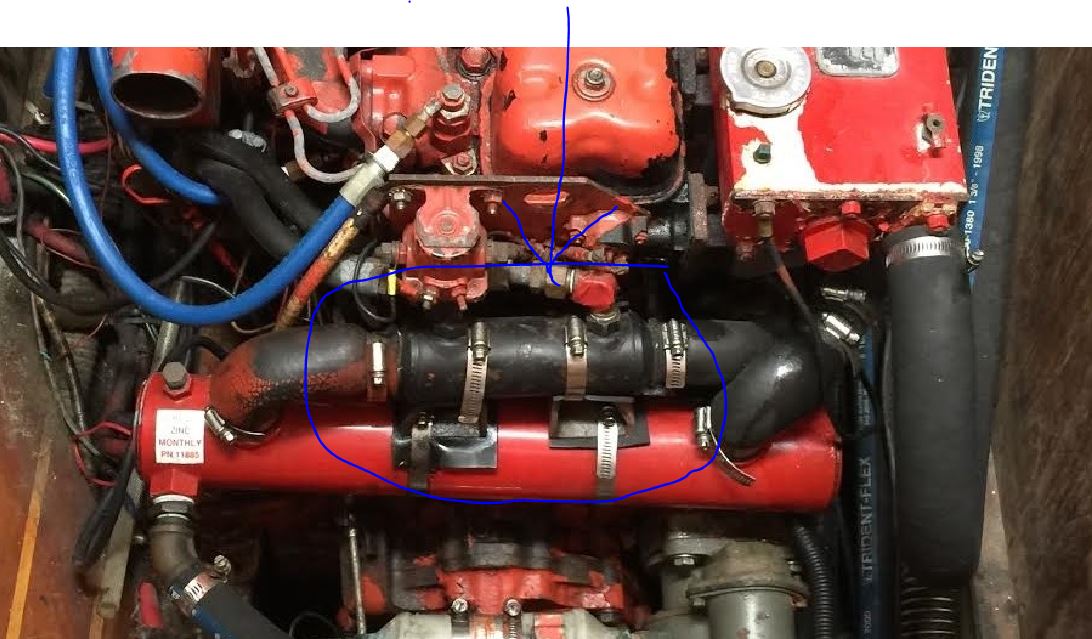
Rich – I also thought the engine did not have an engine oil cooler. Now I see (attached pic with highlight), that there is an engine oil cooler, which probably failed, and that explains why the oil pressure dropped off.
I was a diesel mechanic in the Navy, so I am pretty familiar with the engines overall. Just new to the marine variants.
Alan – in the attached picture, I highlighted what I think might be the engine oil cooler you’re referring to? The HX and trans oil cooler being just below. I did not even realize what was wrapped in all the rubber when I pulled the HX to be serviced!Attachments:
W58-Rear.jpg
-
May 30, 2016 at 5:34 pm #221101Participant
You know, from looking at that picture, it appears that if the engine oil cooler IS in that rubber wrapped section above the heat exchanger, it is connected to coolant flow, not raw water? If so, then I am stumped as to why we had oil coming out of the exhaust.
Alan – is yours just like that? Is your engine oil cooler connected to raw or fresh water system?
-
May 30, 2016 at 6:13 pm #221102ParticipantGood question. Not at boat and won’t be for another week.Pretty sure it’s part of the raw water loop. No sense cooling with 190 degree water.Alan
-
May 30, 2016 at 6:49 pm #221104RichCarterParticipant
It looks like an owner added kludge to me. Maybe others with the same engine can comment.
Change the engine oil at your first opportunity even if there is no sign of water in the crankcase.
Rich
-
May 30, 2016 at 7:04 pm #221106Participant
Thanks Rich. Definitely will do that.
Anyone else have a setup that matches the above-attached pic? I agree that it would be weird to try and cool the engine oil with 180 to 190 degree coolant. The Westerbeke Tech manual does say that engine oil coolers can be on fresh or raw water circuit. Just not getting how engine oil could possibly be present in the exhaust raw water?
-
May 30, 2016 at 7:08 pm #221107ParticipantNo, factory kludge. Mine looked like that. Although I’ve replaced some of the custom rubber hose elbows with easier to find parts.Alan
-
May 30, 2016 at 8:10 pm #221109ParticipantThe oil is under pressure, 50psi or so. If there was a leak in the cooler, the higher pressure oil, (higher than the raw water pressure) the oil would be forced into the water loop. That oil contaminated water is injected into the exhaust at the exhaust elbow.Makes perfect sense.Alan
-
May 30, 2016 at 8:52 pm #221111Participant
Alan
Totally agree assuming the engine oil cooler is actually cooled by raw water. From looking at the diagram on page 27 – Westerbeke Parts Manual (http://www.westerbeke.com/parts%20manual/24577_r2_w58-20wta-yd_parts.pdf), it really looks like the engine oil cooler has fresh water/coolant circulating through it.
Really hoping I’m missing something, and the engine didn’t suffer some kind of chain-reaction event that involved the head gasket, or worse – block or head damage that is causing oil to pour into one of the compression chambers, then out of the exhaust manifold… -
May 31, 2016 at 7:32 am #221114Participant
Something else I realized when talking to my wife about this – when this event happened, we were going through very choppy water, with the boat pitching and healing hard from side to side due to the combined wakes of several (very obnoxious) cigarette boats that were passing us as a group on the bay. Could that have had anything to do with the sudden oil pressure drop, overheat and oil in the exhaust discharge? Wondering if maybe these conditions caused the oil pump to go dry temporarily, and possibly also cause the engine to over-rev, causing blow of oil/fuel into the combustion chambers?
-
May 31, 2016 at 8:07 am #221115ParticipantI can’t conceive of any anything making the engine to over rev, except the prop coming out of the water.Or a temporary loss of load on the engine.Alan
-
May 31, 2016 at 8:00 pm #221122
skipmac
ParticipantI also have the same cooler configuration on my W58.
If you saw oil in the exhaust there’s only so many ways it could get there. One of the most likely is from the cooler. I recently spoke with a diesel mechanic who insisted that oil and transmission coolers like this have a relatively finite life span, a concept that was new to me. He claimed that in the BW certification class he took the instructor was quite definite that anything over 7-8 years these coolers are on borrowed time. If like mine, yours is original then according to him it’s way overdue for failure.
The problem could also be the head gasket but I’m leaning toward the cooler.
It is puzzling that the oil level hasn’t dropped but the drop in oil pressure is very troubling. Could just a small amount of oil caused the effect in the exhaust you saw?
-
June 2, 2016 at 3:40 pm #221129Participant
Great news! Went to the boat, and she started right up, full oil pressure, no smoke, oil/fuel in the exhaust, weird noises or anything else. Didn’t get to take her out to test under load, but I’m going to change the oil/filter before doing that anyway. Apparently, we just ran her too hard and overheated, resulting in low oil pressure, and apparently fuel/carbon getting dumped into the exhaust, not oil.
Dodged a bullet on this one! I’ll keep it under 2400 RPM or so as a rule going forward. Will also check running gear and thru-hulls as well!
Thanks again for all the great input and suggestions!
-
June 2, 2016 at 9:33 pm #221130Participant
The over rev still concerns me. That could be a sign of the transmission slipping. Be sure to check the transmission fluid level before going anywhere.
-
June 3, 2016 at 9:58 am #221137
guy11976
Participant2500 rpm is the max for ordinary running.Sent from my Verizon Wireless 4G LTE smartphone——– Original message ——–
-
June 14, 2016 at 12:26 pm #221191Participant
I believe our Max Prop is one notch on the high side pitch-wise. I’ll be adjusting it down during next haul-out. Engine is running fine now. Definitely will be keeping the RPM’s below 2000 or so till I re-pitch the prop.
-
-
AuthorPosts
- You must be logged in to reply to this topic.