Forum Replies Created
-
AuthorPosts
-
June 14, 2016 at 12:26 pm in reply to: Oil in raw water exhaust – blown trans oil cooler, right? #221191
JWA
ParticipantI believe our Max Prop is one notch on the high side pitch-wise. I’ll be adjusting it down during next haul-out. Engine is running fine now. Definitely will be keeping the RPM’s below 2000 or so till I re-pitch the prop.
June 2, 2016 at 3:40 pm in reply to: Oil in raw water exhaust – blown trans oil cooler, right? #221129ParticipantGreat news! Went to the boat, and she started right up, full oil pressure, no smoke, oil/fuel in the exhaust, weird noises or anything else. Didn’t get to take her out to test under load, but I’m going to change the oil/filter before doing that anyway. Apparently, we just ran her too hard and overheated, resulting in low oil pressure, and apparently fuel/carbon getting dumped into the exhaust, not oil.
Dodged a bullet on this one! I’ll keep it under 2400 RPM or so as a rule going forward. Will also check running gear and thru-hulls as well!
Thanks again for all the great input and suggestions!
May 31, 2016 at 7:32 am in reply to: Oil in raw water exhaust – blown trans oil cooler, right? #221114ParticipantSomething else I realized when talking to my wife about this – when this event happened, we were going through very choppy water, with the boat pitching and healing hard from side to side due to the combined wakes of several (very obnoxious) cigarette boats that were passing us as a group on the bay. Could that have had anything to do with the sudden oil pressure drop, overheat and oil in the exhaust discharge? Wondering if maybe these conditions caused the oil pump to go dry temporarily, and possibly also cause the engine to over-rev, causing blow of oil/fuel into the combustion chambers?
May 30, 2016 at 8:52 pm in reply to: Oil in raw water exhaust – blown trans oil cooler, right? #221111ParticipantAlan
Totally agree assuming the engine oil cooler is actually cooled by raw water. From looking at the diagram on page 27 – Westerbeke Parts Manual (http://www.westerbeke.com/parts%20manual/24577_r2_w58-20wta-yd_parts.pdf), it really looks like the engine oil cooler has fresh water/coolant circulating through it.
Really hoping I’m missing something, and the engine didn’t suffer some kind of chain-reaction event that involved the head gasket, or worse – block or head damage that is causing oil to pour into one of the compression chambers, then out of the exhaust manifold…May 30, 2016 at 7:04 pm in reply to: Oil in raw water exhaust – blown trans oil cooler, right? #221106ParticipantThanks Rich. Definitely will do that.
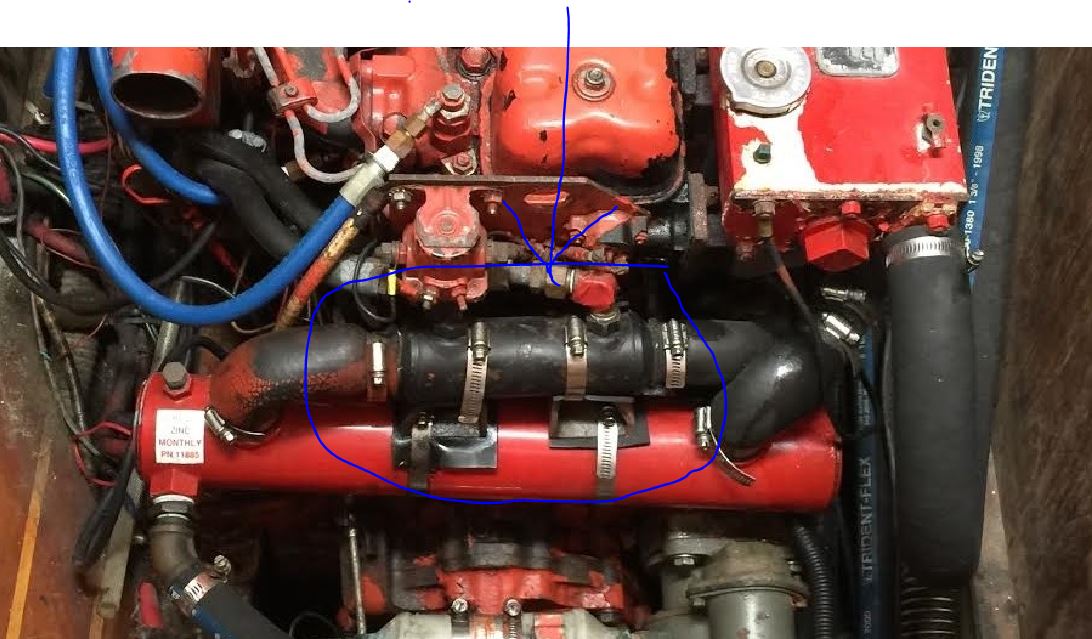
Anyone else have a setup that matches the above-attached pic? I agree that it would be weird to try and cool the engine oil with 180 to 190 degree coolant. The Westerbeke Tech manual does say that engine oil coolers can be on fresh or raw water circuit. Just not getting how engine oil could possibly be present in the exhaust raw water?
May 30, 2016 at 5:34 pm in reply to: Oil in raw water exhaust – blown trans oil cooler, right? #221101ParticipantYou know, from looking at that picture, it appears that if the engine oil cooler IS in that rubber wrapped section above the heat exchanger, it is connected to coolant flow, not raw water? If so, then I am stumped as to why we had oil coming out of the exhaust.
Alan – is yours just like that? Is your engine oil cooler connected to raw or fresh water system?
May 30, 2016 at 4:48 pm in reply to: Oil in raw water exhaust – blown trans oil cooler, right? #221099ParticipantRich and Alan – thanks again for the replies!
Rich – I also thought the engine did not have an engine oil cooler. Now I see (attached pic with highlight), that there is an engine oil cooler, which probably failed, and that explains why the oil pressure dropped off.
I was a diesel mechanic in the Navy, so I am pretty familiar with the engines overall. Just new to the marine variants.
Alan – in the attached picture, I highlighted what I think might be the engine oil cooler you’re referring to? The HX and trans oil cooler being just below. I did not even realize what was wrapped in all the rubber when I pulled the HX to be serviced!Attachments:
W58-Rear.jpg
May 30, 2016 at 12:31 pm in reply to: Oil in raw water exhaust – blown trans oil cooler, right? #221094ParticipantHi Rich.
Thanks for the reply. Should have added that after the event, I checked the engine oil, and it was full and seemed to be just black and not milky or bubbly or anything. I couldn’t think of how a large volume of oil could get into the raw water via a blown head gasket? Where would the breach be in the gasket? Oil would have to get into the actual exhaust manifold, then out the elbow to mix with the raw water, right?ParticipantGuys – thanks for all the input!
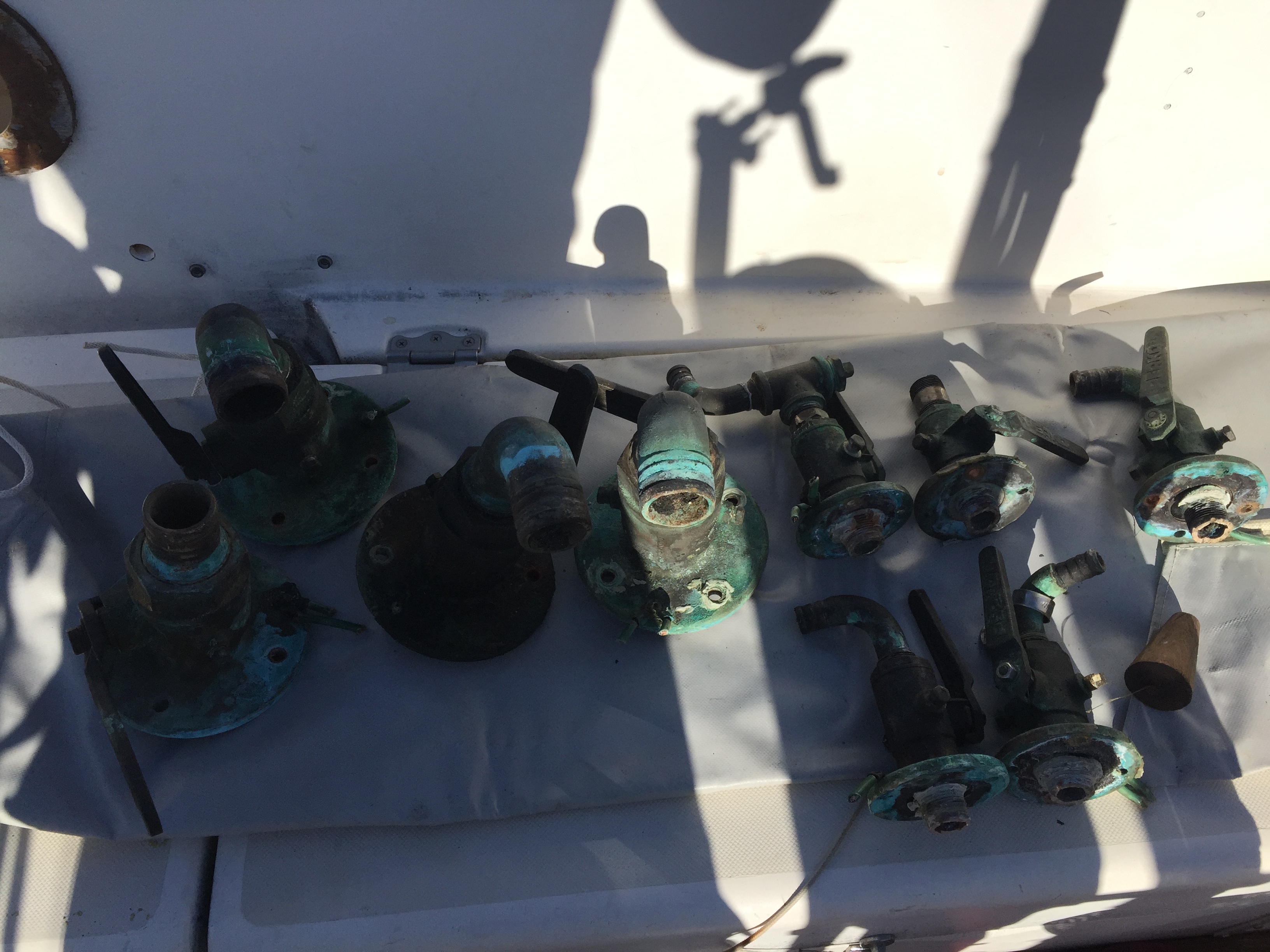
Rich – the bonding system in our boat was a big, partially connected mess when we got her, and most of the below-waterline bronze thru hulls were badly corroded. We decided to replace the sea cocks as well, as the previous installer (looks like an after-market job, as every sea cock has a nice fiberglass backing plate) bedded everything generously with 5200, so unscrewing the thru hulls from outside was not an option. To your question, I used an angle grinder to carefully cut the thru hulls into pie shaped wedges, then used a big chisel and hammer to pry each wedge off, leaving the inside neck of the fitting. We then beat and pried off each sea cock from inside, amazingly leaving each backing plate and the sea cock flange bolts intact.
A pic of 9 of the 11 sea cocks we yanked is attached. $1855 replacement cost all told for 5 1-1/2 and 6 3/4 inch sea cocks and matching thru hull fittings, not counting the straight or 90 degree tail pieces, which are between $10 and $30 a piece.
Thanks again!
ScottAttachments:

IMG_0997.jpg
ParticipantHi Rich
That could well be the case. I was wondering if anyone had actually had this condition with their rudder system, and had went ahead and rebuilt the whole thing from scratch. Like I said, I am just concerned about hidden corrosion with the flange bolts under the surface, and a failure of the whole upper rudder attachment. Probably over-thinking it because of what our surveyor said about “resealing” the flange bolts, but I figured other 424 owners may have dealt with this.Thanks for the reply!
ScottParticipantHi John
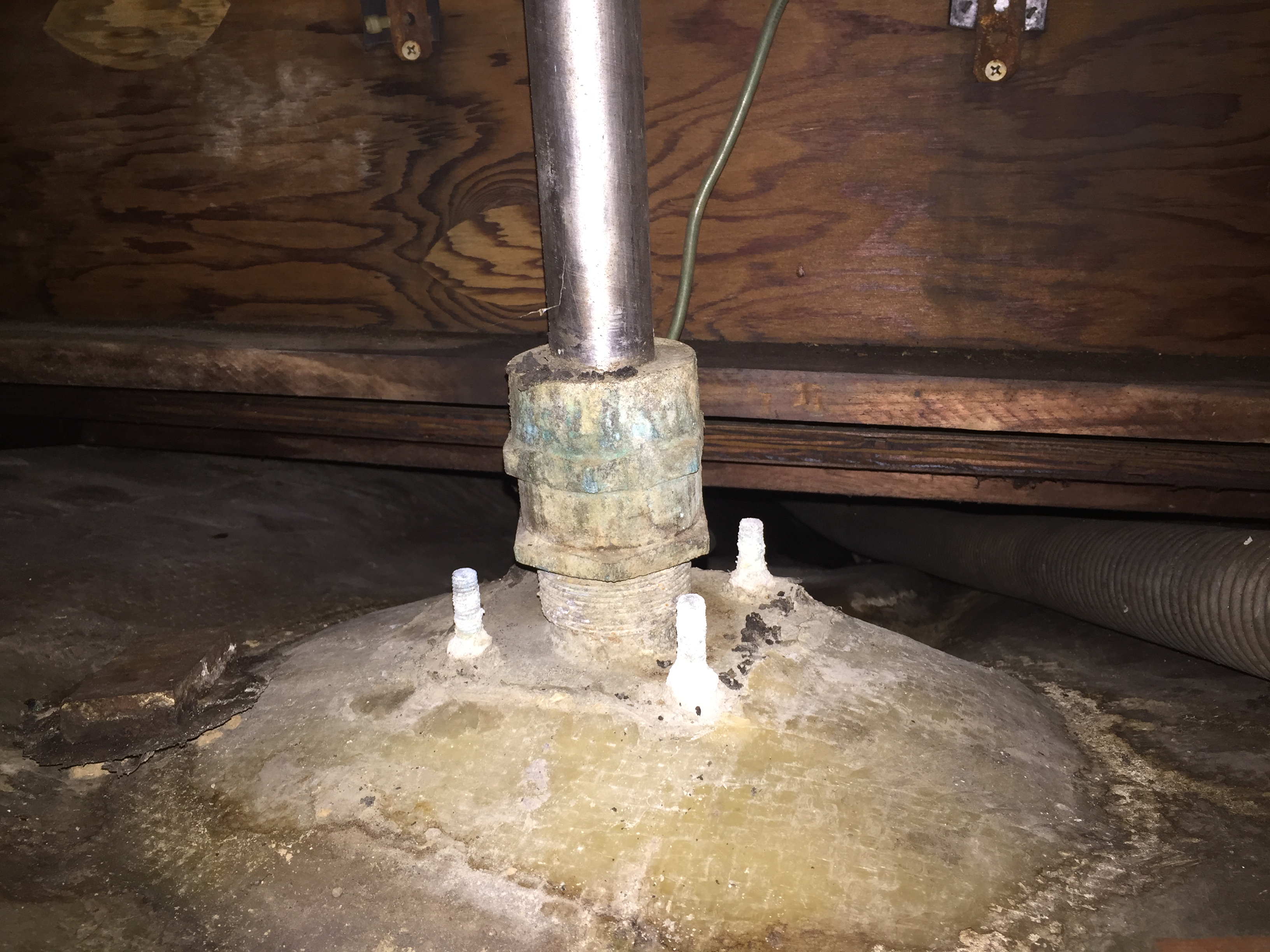
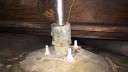
Can’t really see the stuffing box in your pic, but ours is not bad at all really, other than the white corrosion on the flange bolts themselves. Pic of our stuffing box is attached.
I am inclined as well to just re-pack the gland, clean up the corrosion and keep an eye on it. We are also completely redoing the bonding through the boat, so that may keep it under control going forward. I’ve seen a few pics of people’s flange bolts after being removed from the hull and being completely corroded down to nothing where hidden inside the hull. That got me worrying a bit about whether to do the big effort or not!Thanks!
Attachments:
IMG_0980.jpg
ParticipantThanks very much for the reply John!
We are going to re-pack the stuffing box for sure. The issue I’m concerned with is the actual mounting flange for the stuffing box (gland) to the hull, and what is apparently some seeping from around the mounting bolts. Can’t see any actual water coming through with it on the hard, but the bolts are covered with white corrosion, and our surveyor advised “resealing” the flange. There is definitely a slow drip coming into the bilge section fwd of the engine when she’s in the water, so I am hoping that is from the gland needing re-packing.
I took “resealing” to mean lifting/removing the stuffing box, and re-bedding it to the hull around the mounting bolts coming up through the hull. I’m wondering how likely it is that there is serious corrosion of the mounting bolts, and the possibility of a sudden failure and catastrophic leakage with the rudder under load. Obviously, I’d rather not have to drop the rudder and re-glass the whole area, which would include the great fun of disconnecting the quadrant and auto pilot ram, etc…
Just wondering what other people’s experience has been with the flange and mounting bolts getting corroded and whether they re-bedded the flange, or just re-did the whole assembly with new stuffing box/bolts/glass.
Luckily, I have a munchkin-size wife, and she can climb right down in the lazarette! I can get in there upside down myself, but it’s not very comfortable.
Thanks again!
-
This reply was modified 10 years, 8 months ago by
JWA.
-
AuthorPosts