Forum Replies Created
-
AuthorPosts
-
 RichCarterParticipant
I have a solid hull. I did a Bermuda crossing many years ago and got the snot beat out out of us on the way over. The flat bow sections flexed and caused the bulkheads to start separating from the hull. I had this fixed in Bermuda. Briefly, they re-attached the bulkheads and added between 3/8″ and 3/4″ glass on the inside of the hull inside the V-berth. No problems since but I’ve done no more offshore crossings since then. There’s a thread on this website somewhere that discusses the issue.
RichCarterParticipantThe foam doesn’t go bad. It was never good from the factory. As built, my cooler had about 2 inches of foam on the sides and about a half-inch under the coutertop and on the lid. I have engine-driven refrigeration so battery consumption is not an issue. I would get condensation on the countertop on humid days. The only thing I’ve done to improve my system is to replace the lid. As built, the lid was hinged in the middle. You could open one side or the other but to really get in there you need to remove the lid. Where to put it? I replaced it with a well insulated one-piece lid hinged on the back and supported with gas lifts. If I had an electric reefer, I’d have to improve the rest of the insulation or I’d run my batteries down. I assume you’d have to remove the countertop and pull everything out, starting over with proper insulation and a new liner. Someone who’s done this can probably describe what he did.
RichCarterParticipantA water cooled system will almost always be more efficient than an air-cooled system. I assume that the system you have is working. If it ain’t broke, don’t fix it…
You should be able to measure power consumption by looking at the ammeter while it’s running. It likely cycles on and off, so you’d have to record the power reading at regular intervals and average it out to find out what the total draw is. There are instruments that will do this for you but it’s a bit of work to swap one out for what you have just for one measurement. If you’re concerned about power consumption, look first at how your box is insulated. It doesn’t matter how efficient your machinery is if the thing isn’t insulated well.RichCarterParticipantEngine driven or electric motor?
12v or 115v?
holding plates?RichCarterParticipantMy original Datamarine depth transducer was mounted to a wedge shaped block of wood under the galley sink. The wedge orientates it so it’s pointed straight down. I replaced it when I installed Silva Nexus integrated instruments about 20 years ago. I figured it was more useful to know water depth in front of the keel rather than under it so I mounted the transducer up in the V-berth where there is an access lid in the sole. There was a small flat section glassed to the center-line that looked good so I glued the transducer to that spot hoping that the transducer would work through the hull. It didn’t, so I made wood wedges using teak and cut a hole in the hull offcenter next to that flat section. I find the water speed sensor to be pretty useless. It gets fouled frequently and it doesn’t tell me speed over the bottom. I know what the currents are in my area so knowing VHW, water speed, is not helpful.
I’ve always been a bit nervous about putting the transducer up there where it might get whacked by something, possibly holing the boat.
RichCarterParticipant18×12-3 sounds right to me. I have an 18.5×12-3 and it works well on my boat. I have a 75hp engine though. If I had to get a replacement, I’d go for a 13 pitch.
RichCarterParticipantWill you be reusing your transmission or getting a new transmission with your new engine? You need to figure out the rotation speed of your new arrangement. The betamax runs at 2800 RPM. Assuming no change in gearing, is this shaft speed close to what you already have? A good 3-blade folding prop will provide efficiency in forward similar to a fixed-blade prop. If the gear reduction is the same, a prop with the same pitch should provide about the same performance.
I assume you read my notes. http://www.richardcarter.net/repower/Propeller.html
RichRichCarterParticipantRemove the ladder and engine cover lid and slide the engine cover forward. Remove the panel just above the engine. Put some cushions on the engine and lay on it. Be careful to avoid damaging any fuel lines.
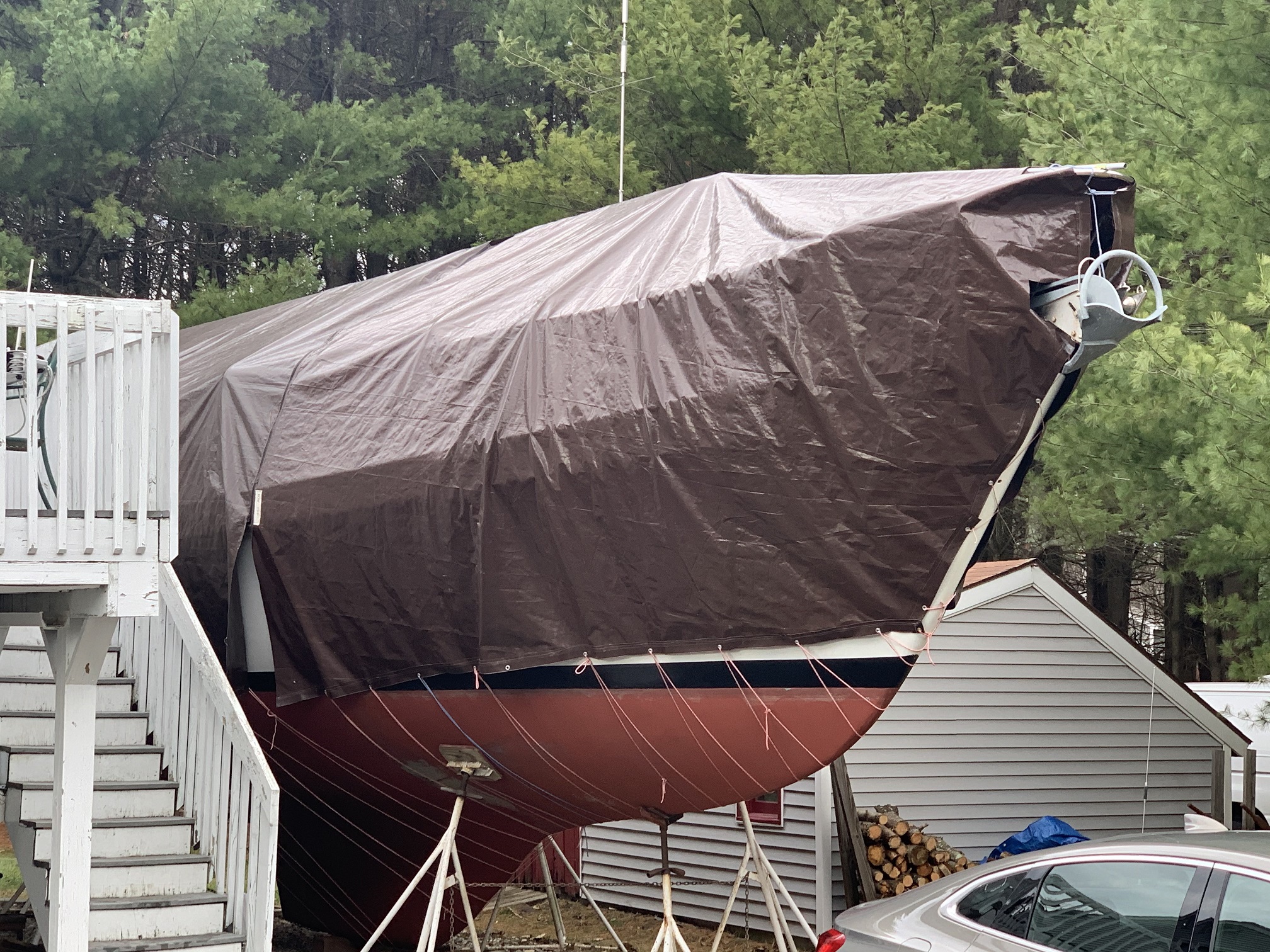
RichCarterParticipantI just finished making a new boat cover to replace my aging cover, photo attached. This is my third. It’s made from three 18×24′ tarps, each 16mil purchased from Amazon for about $100 ea. These tarps are heavier than what is normally available from big-box stores. I expect them to last 15 to 20 years. The center tarp is uncut. The bow and stern tarps are cut to fit the shape of the hull. The boarders of the two end tarps were cut off with their grommets and sewn back on these odd-shaped panels for tying down. The three sections zipper together with a pair of 8′ zippers. Sewing was done with a Sailrite machine. A home machine would not sew this fabric. The frame is made from conduit using frame brackets purchased from Defender. A 24′ 2×8 wood rib runs down the center supported by saw-horse brackets.
The original cover had cut-outs for rigging and masts. I take the mast off for storage so there was no need to do those cut-outs. If anyone wants more info on how the frame was made and sewing hints let me know.
Photo taken at my home where we store our boat. The stairs and deck make winter maintenance a lot easier than a boatyard.
Attachments:
IMG_0525.jpg
RichCarterParticipantEduardo,
Welcome aboard! Are you a member of Winthrop Yacht Club? We’re members of Jubilee Yacht Club on Beverly.
Rich CarterRichCarterParticipantMike
You apparently know about the drawbacks of heating with wood. My home port is just north of Boston so I know about the spring and late fall chill. I put in an externally vented catalytic propane cabin heater many years ago. It works very well. Fuel consumption is a minor issue. I can go through a 6 lb bottle in a weekend. Lugging a tank is a bit easier and a lot cleaner than lugging wood though.
RichRichCarterParticipantMike
What is the purpose of putting a wood stove on your boat? Are you looking for heat, cooking, or just the charm of a wood fire?
RichRichCarterParticipantWhile checking your propane system, check the propane locker drain pipe. It’s copper tubing. If it’s blocked with debris, it can’t vent propane overboard. Checking this is especially important for those of us from colder climates. Water can collect in the pipe and freeze. As you know, water expands when freezing. This can crack the pipe and later allow rain water and gas to leak into the bilge. This has happened to me. I didn’t have a propane leak but I noticed water leaking from the drain pipe.
Make it a point to flush the propane locker each spring to clear it of debris and verify that water doesn’t run into the bilge. Close the tank valves each fall when putting the boat in storage.
I’m in the process of re-plumbing the propane locker. I’m putting in a propane connection for the gas grill. It’s a bit involved but I want to be rid of the green tanks. Parts include a gas valve for the Magma grill, a short rubber hose, quick connect fittings with shutoff valve, copper tubing, a new pressure regulator, and various flare fittings.
RichCarterParticipantI can tell you from experience that the hull will flex a bit when out in rough seas. If you’re coating the inside of the hull with anything, it has to adhere well and not crack when flexed. Have you had to boat out in rough seas after using this stuff? By rough, I mean pounding conditions.
RichCarterParticipantI assume that you are talking about the teak top to the toe-rail and perhaps the outside portion as well. I removed and replaced a section of mine after it was damaged many years ago. In my case, the rail was damaged just forward of the Genoa track for a length of about five feet. I diagonally cut the damaged portion and removed it. I purchased a section of 3/4″ teak and using the old piece as a template, drilled holes to match what I was replacing. I found that the old piece was bedded with either silicon or poly-sulfide caulkI can’t remember which. It came up with no problem. I applied poly-sulfide as a replacement bedding and used Resourcinal 2-part wood glue to bond the replacement to the diagonal cut I made in the old cap. I ran a router with a laminate bit (with wheel guide) down the outside and inside rail to finish fitting it. My boat now has the winter cover on her so I can’t send a photo. Not much to see however, you have to look close to see the replaced piece.
-
AuthorPosts