Forum Replies Created
-
AuthorPosts
-
 RichCarterParticipant
How does the weekend of July 9th sound?
I wish Edgartown were still open. It was a perfect anchorage but is now closed by those misguided tree-huggers. We want a place with no boat-wakes so we can raft. Onsett is nice, but folks water-ski right next to the anchorage and the holding is not that great.
I’m not anxious to get slips though because we would probably get scattered in a marina somewhere. I’d be happy renting a few large moorings for a couple of nights. We could rent three or four large moorings and tie three or four boats to each. Lets not focus on a specific anchorage yet. I thought I’d toss out the idea so folks could plan the date before their calendar gets inked in. Once the marinas open up in the spring I’ll make a few calls to see what I can arrange.
Rich
Original Message
Post generated from Pearson424 Forum using Mail2Forum
RichCarterParticipantDan,
I bought mine on ebay a few years back. Who built it now, was it Lee
Thurner? I don’t know why he put it on ebay. It’s a thing of beauty and
works great in the cockpit. Instructions for building it are in back issues
of the 424 newsletter. Instructions include a drawing for a ketch table.
You can find information in back issues. Buiding such a table is a serious
project and not suggested unless you are good with woodworking. Materials
alone would probably cost over $200, and I would expect it to take about 100
hrs to fabricate. You might find someone who would be willing to build one
for you.I own a sloop. I just finished refinishing the table and I made
modifications to allow a 2kw honda generator to stow underneath the table
top. I had to cut the bottom of the table off to raise it and I extended
the distance between the legs to allow the generator to fit. Photo
attached. I have yet to remount it in the cockpit.Rich
Quote:
Original Message
<.. snip>Post generated from Pearson424 Forum using Mail2Forum
RichCarterParticipantI race the boat, if you can call what I do racing. The numbers are
traveller positions. I can ask the crew to adjust the car to a numbered
position.Rich
Quote:
Original Message
<.. snip>Post generated from Pearson424 Forum using Mail2Forum
RichCarterParticipantTor
I think the same reasoning applies to twin anchor-snumbers. IMHO, a bad
idea.Regards
RichQuote:
Original Message
<.. snip>Post generated from Pearson424 Forum using Mail2Forum
RichCarterParticipantBill
I’ve been suggesting that equal-length pennants is a bad idea for many
years. Almost everybody seems to use them except me. This is odd, since
the document linked below is published in our area. Marblehead harbor is
open to the northeast. Here in New England, the bad weather blows from the
northeast. This makes the harbor particularly dangerous. My 424 sank there
when her mooring chain broke before I owned her. There were eight foot
braking waves in the harbor during that storm. I bought her after she was
rebuilt.http://www.inamarmarine.com/pdf/Moorings.pdf
“No mooring system is complete without a safety
pennant. Some harbors require safety or secondary
pennants. This extra line is inexpensive compared
to the cost of your insurance policy deductible.
The safety pennant should be of equal size
(diameter and strength) and 25%, or three feet
longer (whichever is less) than the primary pennant.
The theory is that the safety pennant will be in
“perfect” condition when the primary fails.
Marblehead has studied this issue and requires
two primary pennants of line, the longer one
being the safety pennant. During Hurricane Bob,
Burr Brothers Boats, in Marion, Massachusetts,
used a storm pennant of 5/8″ poly-reinforced wire
on their vessels which proved to be very successful.
Experience has shown that the primary (or shorter)
pennant should have the chafe gear run from eye
to eye, to prevent it from slipping out of the chock.
The length of the pennant described in many
standards is given as 2.5 times the height of the
free board. At some harbors, the pennant size and
length are based on vessel length.”Rich
Quote:
Original Message
<.. snip>Post generated from Pearson424 Forum using Mail2Forum
RichCarterParticipantJim
Its mostly the horizontal bunk and the shelves above; how they attach to the
hull and forward and aft bulkheads. If you keep them attached, the bow
should hold together.They guy I hired originally proposed glassing in PVC tubing. Since I was on
a tight budget and time constraint at the time he glassed in mat sections of
3/8 thickness by 24″ wide. Each section overlaps to make 3/4″ solid glass
at the overlap. Others laid in wood battens and can comment on how their
job was done. I think the wood battens might work better because they
provide an attachment for horizontal wood strips. Its probably another day
of labor but a little less material.Rich
Quote:
Original Message
Post generated from Pearson424 Forum using Mail2Forum
RichCarterParticipantJames,
There are really two problems up forward, the flat forward section can
oil-can and the tabbing to the forward bulkheads may separate. There are a
number of way to fix this. You can lay in some kind of ribs such as
half-tube pipes of PVC or wood battens covered with glass or you can lay in
several layers of fiberglass. A little oil-canning looks scary, but isn’t
all that dangerous. Having the bulkheads break free is a diffent story. I
read a report regarding a Pearson 53 that was lost in the gulf stream about
15 years ago because her bulkheads broke free but I couldn’t find a
reference link to attach here.Glassing in a frame will probably be stronger than just laying in more
glass, but there could be more labor and therefore it may be more expensive.
Glassing in wood battens would make it easy to put wood strips in to cover
the work. Laying in additional glass with no battens would work but you’ll
need to lay in several layers to build up some thickness. The guy I hired
added in layers of glass, as much as 3/4 inch. No matter which way you go,
overlap the work where the bulkhead tabbing is and I suggest laying the
glass over more area of the shelf and forward bunk than the little bit
Pearson put in there.This kind of job is better hired out unless you know what you are doing.
Grinding the inside is no fun and fumes from the epoxy will rot your brain
unless you have the right gear. Figure about 30 hours of labor plus
materials. The inside surface must be ground down to expose a rough surface
or else the secondary bond won’t work. If you go with battens, they must be
attached firmly before laying in the glasswork. This is usually done by
setting wooden crosspieces in there to hold them firmly against the hull
until the epoxy sets.Regards
RichQuote:
Original Message
Post generated from Pearson424 Forum using Mail2Forum
RichCarterParticipantI wonder if it has anything to do with the type of lubricant you use. I put
SAE-30 in the gearbox and addes some kind of additive as recommeded in the
installation instructions. I change the gear lub each season, but omit the
additive.Rich
Quote:
Original Message
Post generated from Pearson424 Forum using Mail2Forum
RichCarterParticipantJohn,
Interesting read. I don’t remember hearing any backlash with my old w60
installation. I operated it for over 20 years, but the engine was so noisy
that I may not have noticed. I repowerd about 4 years ago with a 75hp
yanmar (4jh3te), an engine similar to yours. I’m pretty sure I had the same
damper plate as your origninal. At that time I rebuilt the velvet-drive and
replace the v-drive. Both the old RV-20 and the new RV-26 make a racket
when in gear. With the cabin sole hatches in place its not that bad, but
the V-drive makes more noise than the engine until I get it up to speed. At
about 6kts, the engine is very quiet and smooth. At idle in gear, there may
be some noise from the v-drive. I think the gears rattle around in the
V-drive, but its not that bad. I almost never run the engine that slow in
gear. I don’t see the point unless I’m waiting for a bridge and need to
compensate for a light wind or current. This is pretty rare for me. I
never shift gears without pausing in neutral and letting the engine idle.About once every couple of weeks I run my boat hard, full throttle for about
20 minutes. This is SOP for this engine. This kicks up quite a stern wave
and makes the boat squat. It will run almost halfway up the transom. Even
with this kind of abuse, I’ve had no issues with the v-drive, transmission,
or damper plate in spite of this abuse. I don’t motor all that much
however, maybe 150 hrs each year.Rich
Quote:
Original Message
Post generated from Pearson424 Forum using Mail2Forum
RichCarterParticipantJohn
Thanks for the tip. Unless you have A/C or electric heat on your boat, I can’t see the need for more than 30A. Here in the northeast, A/C is uncommon. Winters are so harsh that very few folks stay here over the winter.Rich
Original Message
<.. snip>Post generated from Pearson424 Forum using Mail2Forum
RichCarterParticipantI don’t know what the ABYC standard is for shore power but I can guess. If you use plug into two 30A plugs on the dock and feed two independent panels each with its own master breaker, I think you are OK. If you use a single 50 cord with a ‘Y’ cable to two 30A outlets, I would guess you are not in compliance with the law. It doesn’t make sense to do this. If the two outlets are wired to opposite phases of the 220v power, you will trip the breaker or worse fry something when you plug the cable in. If they are on the same phase, you are feeding a 50A cable with a 60A source.
Someone more familiar with the ABYC standard might have a more authoritative opinion.
Rich
Original Message
<.. snip>Post generated from Pearson424 Forum using Mail2Forum
RichCarterParticipantBob
I considered using TREX for decking in my cockpit but decided to go with real teak. I spoke to a guy who did the whole deck on his Pearson Vanguard with the stuff and he’s very happy with the results. He glued it down with epoxy following the West System instructions. The stuff is durable and flexible, but you’d still have to drill holes to mount it. In theory, it could remove the screws after the epoxy sets, but filling the holes without gravity to help might be difficult.Rich
Original Message
<.. snip>Post generated from Pearson424 Forum using Mail2Forum
RichCarterParticipantI don’t know about where you folks sail, but around here in the northeast, 50A outlets are pretty rare. Most marinas have one 30A outlet per slip. Even if you have two 30A inlets on your boat, there is usually noplace to plug the second cord in unless you unplug the cord from the boat next to you. This is not the best way to meet the guy in the next slip 😉
Rich
Original Message
<.. snip>Post generated from Pearson424 Forum using Mail2Forum
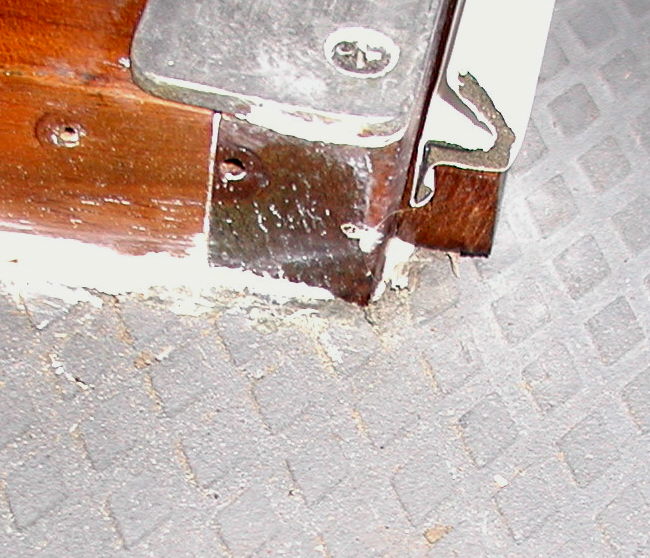
RichCarterParticipantThe gasket material is what’s used for door weather-stripping. Its sold in any hardware store. It comes attached to three pieces of wood that are typically attached to the door frame. I removed the gasket and cut pieces of teak in a similar dimension to hold the gasket in place. The teak trim is attached to the outside edge of the hatch frame.
http://www.richardcarter.net/boat/pix/deckRepair/deckGasket1.JPG
Its not perfect but its easy to install and seems to work for me. Its also easy to replace. The only issue I have is that the hatch has play in it and tends to favor the downhill side of the track. This sometimes allows the gasket to pop-out on that side and I have to open and close the hatch to make it seal properly. I’m planning to put some kind if runner on the inside of the hatch lip so that it doesn’t do this. Its on the list of “things that aren’t broken but could be better”. Its been on that list for years now. At least the hatch doesn’t leak. Even if it were to start leaking again, the deck core is now sealed with epoxy so water won’t get into the deck core.
It is possible for aft edge of the hatch to leak in a heavy rain since there is no gasket there. I don’t find an occasional tiny drip there to be a problem. I sit on a mooring or anchor, leaving the boat to point into the wind. If I were tied to a dock I might find this to be an issue. With the lock hasp hole in the trim, it would be difficult to seal that end of the hatch.
Rich
Original Message
<.. snip>Post generated from Pearson424 Forum using Mail2Forum
RichCarterParticipantQuent,
Someone painted stripes down the edge of his coach-roof to simulate the teak trim. Maybe someone could reply with a link to photos. I’ve lost track of how often I’ve pulled the screws out and rebed them to fix a leak. It would be nice if there were a convenient way to attach the trim without holes. I’ve done this for teak decking, but not something as difficult to attach as this.Rich
Original Message
<.. snip>Post generated from Pearson424 Forum using Mail2Forum
-
AuthorPosts