

Forum Replies Created
-
AuthorPosts
-
Chuck Ruble
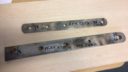
ParticipantSmall chain plate has .5 inch clevis pin opening. Large has 5/8. All the bolt holes are 3/8.
ChuckParticipantRob, I misunderstood you. Filling the holes in the glass laminate is a fine idea. If your new holes produce wet tailings you’ll have a bit more work on your hands but you’ll have fixed another issue. I’m not sure what’s under the laminate. May be solid glass, possibly plywood, don’t really want to know honestly.
ParticipantBill, I repowered with the Cummins. Still working through my refit so I can’t offer long term results.
The beds in the boat should be scrapped. They are junk. Plan to build new. The Cummins has an odd foot print, the front and rear mount brackets were on different planes. If they were supposed to be on the same plane I must have missed something. I fab’d the new beds to accommodate this.
The Velvet drive bolted to the supplied adapter (I told Sheri what I was bolting to the bobtail engine).
The worst obstacle to overcome is Westerbeke dumped the exhaust off the front of the engine with a custom exhaust manifold for the v-drive arrangement. You have to reroute the exhaust around the engine. Getting a substantial drop between the output, injection elbow and lift muffler is a challenge. This is critical. If water can seep back to the exhaust port it can/will result in corossion or worse a hydro locked engine. I see this on boats that have been transported over the road as they can experience forces nobody really gave much consideration for.I like the new common rail Yanmars. They are very quiet! Amazingly quiet. The Cummins is a noisy engine and not a pretty sounding one either. An old Ford Lehman or a 3208 is like a symphony to my ears, the Cummins does not aspire to make music only industrial power. I spent a lot of time creating a tight sound enclosure for the engine to learn the V-drive is a noisy piece of equipment also. Personal ear protection is simpler on long trips I’d think.
The Yanmar 54 would be ample power for our boats. The W60 and W58 were making 48-55 bhp at best. I look at the boat as a slow power boat. I liked the high torque rating on the Cummins and the low rpm value, 2800 at wot. I think the Yanmar is 3600.
Parts for the Komastsu block should be available forever and a day. Cummins built millions of these units. Marcus used the Bowman products also used on the Perkins 4-236 to marinize the engine. As long as he’s around you’ll be able to get those parts in the US as well.
The ZFcone gears supplied with the Yanmars are fine units up to the 54 hp model, the ZF and Kanzaki hydraulic gear are better applications for the 75 and up. Straight output is the current config. You could use a gear with a few degrees of down angle and set the engine closer to level, raising the height of the exhaust output. Not sure if this would impact the limitations of the existing enclosure though.
You’ll need to increase your exhaust diameter. Exhaust hose is expensive.
Move the new engine panel to above the bridge deck. Currently If you fill the cockpit with water your controls are immersed until it drains.
Rule of thumb for pricing a repower, double the engine price. This will give you a safe number to have a shop do it.
If you plan to sell the boat in 5 or so years go with the Yanmar. It won’t frighten the uninformed when they look at it. If you plan to wear out an engine over the next 10-15 years take your pick.
Write a check at a boat show if you want the Yanmar. Best pricing available and they may waive freight.
Hope some of this helps.
ParticipantPatrick, I see a lot of buyers of boats that are really disappointed when the find out all the stuff the surveyor missed.
A survey is a ‘process’ that occurs to satisfy the insurance and or finance company that the boat is not a complete POS and not going to a liability to either company.
You get what you pay for. If you want a job that is really going to carefully examine the nuts and bolts of the boat and find all the warts you should expect to pay $5000 at a minimum. If your guy finds 5 things that are all $1000 each to fix and the seller accommodates that in the sale price, do the math. Owners have passed onto me surveys for me to review and the boat name was not updated through the entire survey from the previous job the surveyor did. ‘Cut and paste survey’. I see the same boilerplate in nearly every one. “Flares are out of date”, really is that what you want to know? I want to know the tabbing is loose around bulk heads, this wad of 5200 was smeared on to clearly stop a leak and is a band aid, not a repair, this boat has a history of water intrusion in the rudder, this boats owner owned stock in JB weld, every turnbuckle is either seized or galled from being seized and subsequent attempted removal…Or, all the issues (and curious methods of repair) with the boat have been documented in various blogs and forums. That’s the sort of work I’d expect from a qualified investigator of boats.
If you spend $3000 on a survey and the surveyor misses an item that costs $4000 to fix, you paid $7000 for a crappy survey but you get a new part thrown in.
Brokers will often supply a list of surveyors. The broker wants you to buy a boat and as much as he’d like to not broker you a lemon, he doesn’t get paid if you don’t by a boat.
Do some research on brokers local to the boat and if you are not satisfied with the selection consider flying one in.
Here’s the other side of the coin. You are buying a boat that is probably no less than 30 years old. If you think your not going to spend a fair sum of money on it after purchase then you might rethink what you are doing.
If you have that understanding and are ready to put the funds towards getting it to your level of expectation then finding an repairing things the surveyor missed shouldn’t be all that painful.The only thing that works on an old boat is the owner….
ParticipantReference photo of early production chain plate dimensions.
Attachments:
IMG_65532.jpg
ParticipantThis link is an example of stock sources. Inexpensive to buy, not much to mill. You can polish them yourself. Best of all they will fit because they were made from your template. Two boats off the same production line are two different boats. Things change as lessons are learned during assembly.
http://www.onlinemetals.com/merchant.cfm?id=27&step=2&top_cat=1
ParticipantNice work! Those were a great find and cleaned up great.
I’ve seen smoked acrylic used for tops also. I’m guessing so you can see something in there that’s not supposed to be?Chuck
ParticipantAlan, a piece of Delrin stock machined to the ID of the opening in the upper support and the OD of the rudder stock would be a simple solution.
Leave a lip so it rests on the beam.
You’d probably want to take the rudder out to do this properly. It’s not a big deal, take the shoe off the skeg (which is probably full of water) and it drops out. Rudder is very heavy.Catalina’s are notorious for loosing the lower bushing as well. There’s a spacer on the stock between the rudder and the hull, it keeps the bushing from falling all the way down when it breaks loose.
Most anything with a spade rudder suffers similar issues. The newer bearings that you see on some of the high end boats work really well and don’t wear out like a solid bushing but they require regular maintenance.ParticipantRob, what you are doing seems to be a lot of extra work and structurally compromises the strength of the plate by adding extra holes. The load on a plate can be substantial. When you fill a hole you are potentially creating a void where water may collect and I promise at some point in time water will get between the plate and its mounting surface. Stainless is compromised by water when introduced to an oxygen starved environment. Adding more spots for corrosion to begin is essentially what you are doing. The thing will corrode eventually, they all do. You’ve now got less to corrode.
You can purchase 316 stainless blanks in the proper dimensions and have them drilled using any one of the old ones as a template (they are all them same less the mizzen plates). A competent machine shop can mill the rounded end and machine the holes, they’ll be clean cuts in the metal. A poor cut is another possibility of crevice corrosion.
Have them polished. This will help fight corrosion.If a surveyor were to look at the chainplate he’d wonder what the heck was up with the extra holes. An explanation of why this was done would probably ensure they are condemned.
Chuck
ParticipantSweeping the bottom with soda, sand or any other media won’t penetrate shouldn’t penetrate the exterior laminate, usually the gel coat. This is done to remove all the exterior coatings. Often it is also when you find out you have laminate issue such as blisters.
The type and depth of the blister determines how much if any laminate needs to be removed. If they are in the laminate and not in the gel coat the peel depth will correspond to the schedule in the laminate where the failure resides. The area is built back up with glass mat and resin, filled sanded and readied for paint.
Chuck
ParticipantShaft measurement is between the beginning of the taper (the wide end) and the coupler face. That’s what the machinist wants to know.
Standard taper, that’s what all prop hubs are.
Aquamet 22 is industry standard. Works.
Always have the coupler faced to the new shaft.
New coupler is cheap. Don’t reuse. Just don’t.
Don’t use split couplers.
New shaft should show up with new nuts.Max Prop hub requires the last bit to be cut off. If you plan to use a Michigan Sailor or such as a spare remember you can’t get a jam nut on there. Have a hole drilled in the end for a cotter pin. If you one nut loosens up you won’t loose anything. I promise you’ll know when it’s loose. Yes it had a hole for a cotter pin but you cut that off…
If you bent something the alignment needs to be checked. The lip seal on the output end of the v-drive won’t tolerate being out of alignment. It will leak.
Chuck
ParticipantRob, it’s a floor support. It’s factory. The only thing wrong is there aren’t enough of them. The light laminate wasn’t thoroughly saturated.
It’s not coming apart. There’s plenty there still holding it in place.
Grinding laminate should be the last resort. It’s very messy.
Every soft product in the boat needs to be removed. Glass dust will get everywhere.
Paint the bilge with some Bilgekote and it will go away.ParticipantDavid, Did you sand your surface flat or did you roll over the pattern? We usually put a coat (Awlgrip) down, scatter the griptex then apply another coat to lock it together. Makes for a uniform distribution of grit. Spraying yields really tight adhesion but rolling is really easy, no bagging.
I’m interested to see how the Interdeck holds up.
Where in FL?
ChuckSeptember 22, 2016 at 3:28 pm in reply to: Prop Strut casting – anyone have a place to purchase? #221605ParticipantRob, glad the information helped you out. Very kind of you to share the information you acquired.
Chuck
ParticipantThe laminate at the bottom of the aft end is a spot that was hard to access during construction. It’s inherently weak. None the less when it was new it was strong enough to support the weight of the boat. A failed repair or unprepared damage will not tolerate a load especially if water has migrated into the laminate.
The simple fix is to take a sawzall to the aft end above the damage and cut parallel to the bottom of the keel till you reach the encapsulated portion.
You want to be cutting clean laminate. The secondary bond needs clean, uncontaminated laminate to bond too.
Make a template by tracing the outline of the remaining keel on cardboard. Use this to create a laminate stack that matches what you cut off. Using screw and glue method epoxy it to the bottom. You’ll need to add some cleats to screw it to. These can be glassed to the inner hull. Easy place to work when it’s opened.
Garolite would be the best material to create the stack with.
Grind it to match and wrap a few layers of glass around it using a vacuum bag.
It will be rock solid.
I’m told Mr. Shaw had the plug available as a kit at one point.
Chuck -
AuthorPosts
