Forum Replies Created
-
AuthorPosts
-
 RichCarterParticipant
Bob
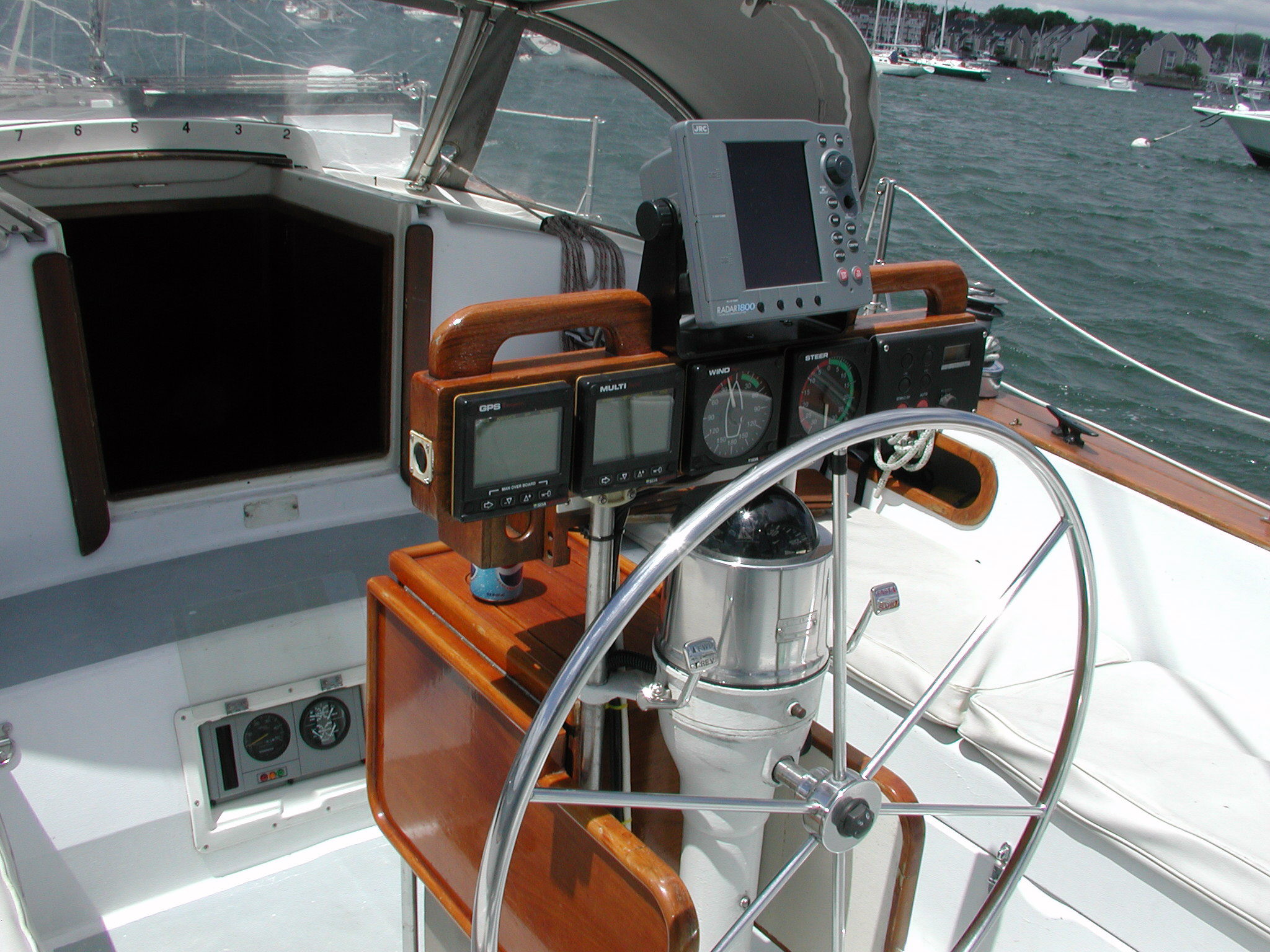
I’ve got cockpit table mounted there. There’s room for a small generator under the table, but height and width are restricted. If I were to make my own table, I’d plan the dimensions properly so that a generator would stow below. I estimate that it would take about $250 in materials and about 100 hours to make a replacement. Not something on my to-do list yet.http://www.richardcarter.net/boat/pix/binnacleJPG.jpg
Regards
Rich
Original Message
<.. snip>Post generated from Pearson424 Forum using Mail2Forum
RichCarterParticipantAaron,
Yes, I’m aware of the capacity limitation. Here’s an interesting article.
http://www.campinglife.com/output.cfm?ID=1112113I went down to a local power equipment dealer and physically measured what they have available. The Yamaha EF2400 is way too big. The EU2000 is only slightly larger than the EU1000, but it won’t fit under my cockpit table. I took a look in the classifieds and on craig’s list and see no EU2000’s listed. Even if I could find one, there is no convenient space to stow it. Too bad the tank isn’t removable. That would make it easy to refill and you could just stow the tank in a wet-locker and stow the unit below after running it dry. It might even be possible to share the dinghy tank with the generator. I made that suggestion to Honda years ago in a nicely worded letter. They ignored the suggestion.
I’m supposed to look at an EU1000 tomorrow. I have yet to negotiate a final price on the unit. The seller is asking $375. I’ll see what condition it looks like and try to adjust the price. I doubt the EU1000 will have enough power to run my microwave but I’ll try it out. I figure that if I can redo the space under the table someday I might fit the EU2000, or maybe someone will come out with a smaller unit. I’m pretty sure I can resell the EU1000 for about what I’ll pay for it at a later date.
If I had 12v refrigeration like most folks, I’d probably favor the EU2000 because it can make hot water (if you either reduce or disconnect your battery charger). You folks will have to find or make a place to stow it.
Regards
Rich
Original Message
<.. snip>Post generated from Pearson424 Forum using Mail2Forum
RichCarterParticipantNo, just inverter on/off. There’s no switch for the charger. Its on if the thing is plugged in to shore power.
Original Message
<.. snip>Post generated from Pearson424 Forum using Mail2Forum
RichCarterParticipantLinus
I have a Heart inverter/charger. My inverter has an on/off switch. This turns off the inverter, but doesn’t disconnect the battery charger. I’ve been bitten by this many times when connected to shore power. I’ve disconnected the battery switch so that I work on a 12v circuit forgetting that the charger is still feeding the breaker panel. With only 12v on the circuit, there’s little danger of serious injury, but it can still give you a burn. If I want to service my 115v wiring, I simply pull the main AC breaker. The inverter isn’t normally on anyway.My inverter is mounted in the back shelf in the hanging locker. This makes it very awkward to reach the on/off switch. I connected switch and a remote relay where the switch was. I added a toggle switch to the breaker panel that controls the relay. The switch has three positions “on-off-auto”. The “auto” position closes the relay when the engine is running (from the key). The “on” position closes the relay even if the ignition switch is off. The “off” position of course leaves the inverter off. I normally leave the switch in the “auto” position. When the engine is running, the 115v outlets in the boat are energized. I can run the microwave when the engine is running. If I want to watch TV or use a power tool when the engine is off, I turn it to the “on” position. I don’t microwave stuff when the engine is off because it’s a battery killer. With a small generator, I should be able to microwave stuff without turning the engine on. I pick up the Honda EU1000 generator tomorrow afternoon.
Rich
Original Message
<.. snip>Post generated from Pearson424 Forum using Mail2Forum
RichCarterParticipantI just figured out how to disconnect my battery charger. (I do some of my best thinking in the shower.) My Heart inverter/charger is connected to the battery selector switch so I can charge either bank or both. If I select neither bank, the charger will feed my breaker panel, but neither battery will charge. This means that a Honda E2000 generator would make hot water. When making hot water, I’d have to disconnect the batteries via the selector switch. When the water heater finishes heating the tank, I could turn off the water heater breaker and turn the battery bank back on. The only issue is to remember to reconnect the battery before starting the engine, otherwise I’d blow the diodes in the alternator. Normally, the boat won’t start the engine with the selector off, but if the generator were running and someone hit the starter button it would probably damage the alternator.
I’m still going with a used E1000 generator. If I find room to conveniently mount the bigger E2000, I might upgrade later. Getting rid of a used E1000 should be pretty easy. Once folks at my Yacht club see how convenient it is, they’ll all want one.
Rich
Original Message
<.. snip>Post generated from Pearson424 Forum using Mail2Forum
RichCarterParticipantJohn
$400 seems reasonable. If the stock runs under $200, that leaves $200 for labor. I would think a good machine shop should be able to cut and drill a set of six plates in a couple of hours. I called a couple of rigging shops and got quotes over $200 for one chainplate.My plan has been to keep water out of the deck and out of the chainplates. This means rebedding the chainplates every couple of years. I’m trying a new caulk that might last longer however. If you can keep the water out, I expect the chainplates to last indefinately. Did you consider just polishing and inspecting your existing plates before replacing them?
I recently had a screw head from one of the stanchion fasteners snap off. There was no obvious reason for this. I suspect crevice corrosion.
BTW: lose any bronze toggles that remain in your rigging. My rigger tells me that some insurance companies are refusing claims caused by failures of these. He’s replacing with stainless. All mine are gone.
Regards
Rich
Original Message
<.. snip>Post generated from Pearson424 Forum using Mail2Forum
RichCarterParticipantYes, I polished the chainplates. Polishing is straightforward. An hour should be more than enough to polish the set of six. You first clean them off with a flap-sander on a hand-held grinder. I suppose you could use a bench grinder too if you can get it to fit. You then use a starbrite pad mounted on the same grinder with Mother’s mag cleaner. There are typically a set of four starbrite pads in a polishing set. This will get them buffed to a pretty good shine in a few minutes, but the electro-polishing process removes surface contaminates rather than just rubbing them smooth. You’re only going to have a couple of inches of chainplate visible. At that, it will be hidden by deck caulk and chafe tape. I think hand polishing is just fine.
Rich
Original Message
<.. snip>Post generated from Pearson424 Forum using Mail2Forum
RichCarterParticipantThatcher
I wouldn’t use 5200 to fill deck holes. Instead, I’d fill it in with something like west system epoxy with filler. West has instructions for mixing this or ask us for more info.Rich
Original Message
<.. snip>Post generated from Pearson424 Forum using Mail2Forum
RichCarterParticipantI’ve replaced only the transom chainplate in my sloop. I investigated replacing the other chainplates and have a couple of comments.
The rigging vendors want big bucks for a chainplate. Maybe someone on the list knows where they can be purchased reasonably but I haven’t found a source.
I bought my own stock and cut and drilled my transom chainplate. This was a bigger job than it might seem.
http://www.richardcarter.net/boat/TransomChainPlate/From that project, I learned that cutting and drilling your own isn’t a big deal. Stock is relatively inexpensive. You’ve got six chainplates. I’d estimate stainless stock at about $150 for the set. Cutting is simple if you invest in a cutoff saw (approx $100). You also need a drill-press and cobalt drill bits to cut the holes. If you center-punch the holes and then drill successively larger holes, say 1/4, 3/8, and 1/2, you should be able to drill out one plate in about an hour. If you are careful and use cutting oil, the drill bits should last for the job. Since you’re making six of these, it might be worth wile to make a jig for the pilot holes if they are all identical.
In retrospect, I should have sent the plate out to be electro-polished. For the stays, this may not be important since they are basically below deck.
Regards
Rich
Original Message
<.. snip>Post generated from Pearson424 Forum using Mail2Forum
RichCarterParticipantThatcher,
Yes, it should be that simple. Use heavy gauge wire, number 8 should be good for up to a 30 foot run. Putting the controller close to your batteries would let you go up a size to 10AWG. Don’t forget to fill-in any holes from the old panel to keep water out of your doghouse.
Rich
Original Message
<.. snip>Post generated from Pearson424 Forum using Mail2Forum
RichCarterParticipantThatcher
Solar panels are rated for open-circuit voltage and rated current at typical load. They normally need a voltage regulator, but small panels can be directly wired to large battery banks. As a rule of thumb, if the rated current for your panel is less than 3% of your battery rating in amp-hours, you can skip the regulator. If for instance you have a 100AH battery bank, you could directly connect a 3A solar panel with no regulator. This assumes that your battery use would be typical, weekends and such. If you expect to leave the batteries on charge and not used for weeks at a time, don’t do this. All solar panels need a blocking diode to prevent loss in the panel when its dark. Some panels include the blocking diode and regulators all have a blocking diode. Regulators have power loss. They typically drop about 1.2V. If you charge your batteries to 13.8v, you need a solar panel that puts out 15v at rated load minimum. I’d recommend 16v. Some panels put out less. If the panel is rated for 14v, you can’t use a regulator and if it doesn’t include a built-in isolation diode, you can’t add one.If your panel shows signs of corrosion inside the glass, its hosed. The next most common failure is corrosion where the wires connect to the panel. When the sun is shining on the panel, connect a voltmeter to the wires where they connect to the panel. You should read somewhere between 13 and 16 volts. If you read higher, the panel probably isn’t connected to anything, possibly a defective regulator, blown isolation diode or broken wire. If you read zero volts, there’s likely a short somewhere or the wires aren’t connected to the panel properly. If you read somewhere below 12v, your panel may be damaged.
What you’ve described sounds like a tiny solar panel, something in the one-amp range. I wouldn’t bother replacing it. If you want to charge your batteries, you’ll need a bigger panel. What you’ve described is barely big enough to trickle-charge your bank.
Harbor freight has a regulator for $20. I don’t know how good it is, but there’s not all that much in there to go wrong.
http://www.harborfreight.com/cpi/ctaf/displayitem.taf?Itemnumber=96728I don’t recommend their solar panels.
Hope this helps
Regards
Rich
Original Message
<.. snip>Post generated from Pearson424 Forum using Mail2Forum
RichCarterParticipantBob
I have dual alternators and a dedicated starter battery. I can’t conceive of a situation where I couldn’t start my engine due to lack of power. I’ll be getting one simply to be able to charge my batteries in those infrequent situations when the one hour each day of engine running time isn’t enough. This happens when we watch too much TV. My flat-screen TV uses about 200W. It should also do a better job of running the microwave oven too. It will also be handy to lend out to a buddy when he can’t start his engine because he ran his batteries down. It won’t make hot water, but I get hot water from the engine anyway. I have this otherwise unused space under the cockpit table. A Honda EU1000 will fit under there.Regards
Rich
Original Message
<.. snip>Post generated from Pearson424 Forum using Mail2Forum
RichCarterParticipantI think you will find that your fuel return line is the same size as brake lines used in automobiles. You should be able to cut out the damaged piece and splice in a piece of brake line using compression fittings.
Regards
Rich
BlackSheep #47
Original Message
<.. snip>Post generated from Pearson424 Forum using Mail2Forum
RichCarterParticipantTor
Yes, I meant inside the combing, but as I just reported, the generators are still bulky for my needs. I’ll keep my eyes open for something more space efficient.Rich
Original Message
<.. snip>Post generated from Pearson424 Forum using Mail2Forum
RichCarterParticipantWith all this generator talk, I got interested enough to take a look at what is available. According to my calculations, I need 2kw continuous power to make hot water and charge my batteries. If I could buy a small generator that does this for around a grand or less, I’d be interested in getting one. So far, I’ve seen nothing that will do. Most of them put out around 1kw. Honda makes an E2000 generator, but it puts out only 1.6kw continuous. This will make hot water or charge batteries, but not both. Even at that, its just a little bigger than I want to handle. Maybe the technology hasn’t caught up to my needs.
Regards
Rich
Original Message
<.. snip>Post generated from Pearson424 Forum using Mail2Forum
-
AuthorPosts