Forum Replies Created
-
AuthorPosts
-
 RichCarterParticipant
I’ve owned a few dozen amateur radio SSB rigs over the years. Restoring them is one of my hobbies. Most modern HF rigs will operate on the marine bands with a simple modification. The modification varies from radio to radio, but usually involves opening the radio and cutting a wire or clipping off a diode. Specific information can be found at http://www.ham.dmz.ro/. Modifications such as this will allow transmission in the marine SSB band allocation. Receive usually requires no modification. While technically these radios are perfectly capable of operating in the marine bands, they are not type approved for such operation. This means the the FCC has not approved use of these radios in the marine bands. If ham radios are perfectly capable of operating in the marine bands, why don’t the radio manufacturers apply for marine band type approval for their amateur rigs? I believe that they repackage their amateur radios in different cases and sell them as approved marine
rigs e
ven though internally the radios are almost identical. In the case of a marine band radio, they would remove some features that someone with limited knowledge of radios would find confusing such as RF gain, IF shift, and filtering. Since the radios are internally identical, they can be sold as being usable on amateur bands. The only difference then is that the marine band version has been lobotomized and they jack up the price.If you get caught operating a non approved radio in the marine bands you could get slapped with a fine. While the FCC has the right to impose a fine, I’ve never heard of a fine being imposed for this kind of thing. It is more likely that the offender would receive a letter of complaint from the FCC and would have to respond in writing. This assumes that the FCC catches you. If your radio sounds like a marine radio, how could they know? If you plan to use an amateur radio on the marine bands, you probably want to get one that has a high stability VFO. This is standard on marine radios and is usually an option on amateur radios. This will keep your frequency stable and make the amateur radio sound exactly like a marine SSB. Most cruising folks don’t bother to spend the extra money for a radio with a high-stability VFO because most modern rigs are pretty stable even if they don’t have the option installed. It’s nice to have the option, but you don’t really need it. O
f cour
se, you can always operate anything anywhere in an emergency.I have a marine band SSB radio installed in my nav station. In addition to the marine band radio, I have an amateur radio also installed. That way I can legally operate in either service and I have the capability of a full featured amateur radio. Most radios, both marine and amateur, designed for mobile installation come in small cases and have limited cooling capability. They won’t run digital operations for extended periods of time. They have thermal protection so they won’t get damaged however. They will just cut back their power if they overheat. I run digital operations using my radios frequently and have no problem with overheating. There are many digital modes. It is possible that some radios may have issues with overheating using some modes such as Pactor. If you are considering using any radio for extended length digitial transmissions, I suggest contacting someone who is familiar with the mode to discuss possible problems.
I recommend a used ICOM-706 as a good second HF radio. At only about $400, they are a good value and make a very good amateur radio. They are small and easy to mount too. As I’ve said many times, there are better radios out there, but they are marginally better and most are much more expensive.
http://www.richardcarter.net/radio/
—
Rich Carter
Start of attached email. Subject: RE: ICOM 706
End of attached email
To unsubscribe, e-mail:
For additional commands, e-mail:Post generated from Pearson424 Forum using Mail2Forum
RichCarterParticipant405
from
http://www.pearson365.com/forum/index.php—
Rich Carter
Original message
<.. snip>Post generated from Pearson424 Forum using Mail2Forum
RichCarterParticipantMy boat came with a W60 which had a pull-cable that was positioned near the right ankle of the helmsman, I assumed that the W58 had a similar arrangement. I’d be surprised to find that Westerbeke changed to a solenoid actuator. A bad ignition switch could cause power to the panel and engine to become intermittent. If this is the case, you could observe the problem by viewing gauges while tapping on the key switch. A squirt of PB-Blaster in the key hole will likely fix the switch.
A stock 424 will not turn-over unless the key is turned on. Most key switches are interlocked so that the first position energizes the panel and the second position engages the starter. There is no reason that it must be wired this way but it makes sense.
As I remember, my boat came with a wiring diagram, but the engine harness didn’t match the diagram. I wired my own panel when I repowered and found what should be a simple task to be quite complicated. Finding the engine sensors and tracing the wires was time consuming. I didn’t use a key switch because they are unreliable if mounted in a wet environment such as an open cockpit. Instead, I used a water resistant pull switch and two water resistant buttons. Pearson mounted the key switch inside the starboard lazarette. Now there’s a convenient place to reach in an emergency!
—
Rich Carter
Original message
<.. snip>Post generated from Pearson424 Forum using Mail2Forum
RichCarterParticipantAaron
If you can get your hands on a refrigeration compressor mount for the W60, you could bolt an alternator mount to it. Some assembly required.Rich
Quote:Post generated from Pearson424 Forum using Mail2Forum
RichCarterParticipantHoward
I believe you said that you have a W58. I don’t believe that your engine has a fuel shutoff solenoid actuator. I think the stock W58 has a shutoff cable. Someone might have installed a shutoff solenoid actuator and removed the cable. When you turn your key off, what turns the fuel off to the high pressure pump? Try turning the key on and off while looking at the fuel pump on the side of the engine. Something has to move. Send a photo if you can.424’s came with an electonic fuel valve at the top of the tank. This is not the same thing as a solenoid actuator. Does your fuel tank have an electric fuel valve on the top of the tank? There would be two wires running to it.
Rich
Quote:<.. snip>Post generated from Pearson424 Forum using Mail2Forum
RichCarterParticipantAdam
You can put an electric fuel pump in series with the manual lift pump and wire it to the engine key. No need for additional switches or valves. This has the additional benefit of making bleeding the injectors much easier. $42.80 including shipping. You’ll need to purchase brass hose barbs.http://www.amazon.com/Airtex-E8012S-Electric-Fuel-Pump/dp/B000DT7Y7A
—
Rich Carter
Original message
<.. snip>Post generated from Pearson424 Forum using Mail2Forum
RichCarterParticipantIt sounds like your engine is starved for fuel. If it were sucking air into the lines, it would be hard to start.
My 424 came with an electronic solenoid shutoff valve located on the top of the tank. The engine exhibited similar problems until the valve was removed.
another problem that can cause the same symptom is a clogged fuel system. Dirty filters or sediment collecting in the lines or the bottom of the tank can cause fuel starvation.
A weak lift pump can also cause the same problem. If its the lift pump, your engine will behave fine with the tank full, but starve for fuel when the tank level gets low. If it is a lift pump issue, put in an electric fuel pump.
—
Rich Carter
Original message
<.. snip>Post generated from Pearson424 Forum using Mail2Forum
RichCarterParticipantLee
I’ve been using Nobletec VNS for many years now. It interfaces with tides-and-currents to display tidal information on an hourly basis right on the screen. If you cruise in areas that have strong currents, this is a very valuable feature.
http://www.nobeltec.com/products/prod_suite.aspRich
Quote:<.. snip>Post generated from Pearson424 Forum using Mail2Forum
RichCarterParticipantCool Pat,
Your side decks look much wider with the lifelines moved out. I never liked the stanchions as installed by Pearson. The deck is not properly reinforced, the gate supports are weak, and the lifeline is too low to properly clear the winch crank handle. I’ve been considering replacing at least the two gate stanchions with something taller and stronger. Its on the list of things that “ain’t broke but don’t work well”. I may never get to it.What did Gauhauer charge for the stanchions?
—
Rich Carter
Original message
<.. snip>Post generated from Pearson424 Forum using Mail2Forum
RichCarterParticipantPhil
I think you are on the right track. Ambering would only result over time if the area is exposed to sunlight. It must be water working its way into the sole. This will eventually cause problems. There are three sources for water in the sole at the base of the main cabin ladder, the starboard water tank, the head, or the vented loop. In the last two cases, you’d be able to either see or smell a problem. I suspect the starboard water tank.—
Rich Carter
Original message
<.. snip>Post generated from Pearson424 Forum using Mail2Forum
RichCarterParticipantAaron
Putting the batteries in the starboard locker doesn’t make a lot of sense. At one point in time, I had large 6v batteries in there, like golf-cart batteries but much taller and heavier. It gave the boat a permanent list. I relocated the batteries to the bilge just forward of the sump. This puts them out of the way and where the weight will do some good. The drawback with this is that if you boat floods, your batteries will be under water. I have a separate starting battery that is on the shelf inside the hanging locker, so even if the bilge floods I still have power until that is underwater too. By then, I have bigger problems. I cut out the battery box and now have a huge locker for storage. Its full of stuff of course. Someone installed them under the steering quadrant. My autopilot is there, so I couldn’t do the same. This limits the height of the battery, but otherwise looks to be a good spot if yours will fit.
https://www.pearson424.org/gallery/album08The pull cable is expensive to replace and IMHO is a dumb idea. I tore it out and replace it with a solenoid lever made for that kind of thing. When you turn the key on, the solenoid pushes the kill lever to “ON” and when you turn the key off it returns it to “OFF”; just like a car.
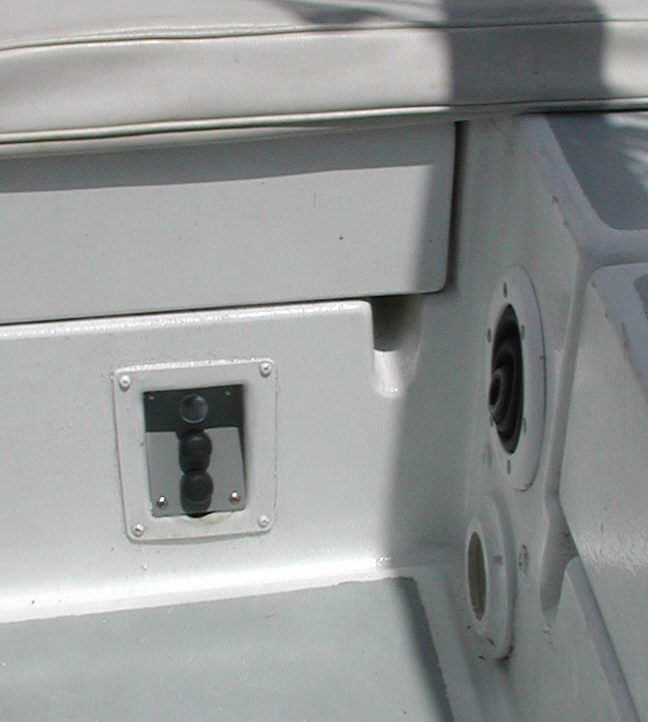
I replaced the engine three years ago with a Yanmar. They have a cutoff solenoid as part of the stock engine. They have it backwards however. Apply power to the solenoid to kill the engine. This means that you need an off-button. This is what the panel looks like now.
http://www.richardcarter.net/boat/pix/key.JPG
I have no key on the panel. The top switch pulls out to supply power to the panel. The red button stops the engine, green starts it. I also put a key just above the engine so I can start the engine from inside the boat when working on it.
—
Rich Carter
Original message
<.. snip>Post generated from Pearson424 Forum using Mail2Forum
RichCarterParticipantLee
I’ve never had my headliner out back there and now you have me wondering. My first concern would be water intrusion into the cored deck. As long as you have the headliner out, I might suggest removing the fasteners and fixing the holes so that water can’t get into the deck core. As long as you’re drilling them out, a larger fastener on at least the outboard end along with a backing plate sounds advisable. You’ll have to get your hands on a long drill-bit to get at the holes without removing the bridge.—
Rich Carter
Original message
<.. snip>Post generated from Pearson424 Forum using Mail2Forum
RichCarterParticipantPaul
That’s a pretty good idea. You may find the fans to be noisy, but you can put a small series resistor in there to slow the fan down and reduce noise. The most efficient way to do this is to connect the pair in series with no resistor. If you only have one or have an odd number, you can measure the resistance of one fan and put a resistor of similar size in series. The resistor method lets you fool with the value if you want to fine tune the speed for minimal noise.—
Rich Carter
Original message
<.. snip>Post generated from Pearson424 Forum using Mail2Forum
RichCarterParticipantI mounted one up in the V-berth coachroof. I removed a chimney that was installed through there and needed to do something with the hole. They last a few years before failing. I suspect that the motor brushes fail. There is no way to service the motor. I’ve replace it once already and the replacement too has failed. Even when it worked, it didn’t push much air. IMHO, don’t waste your money.
I’ll replace it once again with a non-solar unit. The are designed to draw air up through them using a venturi effect whenever air passes over them. This works day or night as long as the wind blows.
There are occasions when the interior gets hot, yet there is no ventilation. This happens on a hot day if there is no wind or if its raining and you can’t open the hatches. Both conditions are rare here in the northeast, but there are other areas of the world where it is common. I purchased a couple of cheap 12v cabin fans for such occasions.
—
Rich Carter
Original message
<.. snip>Post generated from Pearson424 Forum using Mail2Forum
RichCarterParticipantLee
That’s a good question. I know that Pearson switched to cored hulls at some point during production. No two 424’s are the same, so I’m sure it would vary from boat to boat. Unless you repair damage or cut a hole in the hull or deck somewhere I don’t know how you could determine thickness and quality. I repaired the deck rot around my main cabin companionway hatch and found the deck to be cored with about 1/2″ of balsa sandwiched between two 1/8″ layers of glass. I would expect all the decks to be the same. I’d be hesitant to attach high-load rigging to the deck unless it were reinforced. I think you’d crush the balsa core.—
Rich Carter
Original message
<.. snip>Post generated from Pearson424 Forum using Mail2Forum
-
AuthorPosts