Forum Replies Created
-
AuthorPosts
-
 RichCarterParticipant
Linus
Congratulations on your new engine. I’m sure you’ll be happy with your investment.For comparison, my Yanmar runs relatively smoothly at all speeds. If I stand on the cabin sole next to the engine, I can feel vibration in the soles of my feet at cruising speed. Anywhere else in the boat it runs with little vibration.
With the engine cover on, it is also quiet. I had to play with the V-drive alignment to get the drive-train to run smoothly. I tweeked the alignment about a half-dozen times until I got it right. If you find that your engine runs rough in gear, but smooth in neutral, you might look at your alignment and running gear.
—
Rich Carter – BlackSheep #47
Original message
Post generated from Pearson424 Forum using Mail2Forum
RichCarterParticipantSofter mounts will probably not translate to less vibration. The mounts resonate at different frequencies based on how much weight is on them. Going to a softer mount will mean that it resonates at a lower frequency, which may be more uncomfortable. There’s a writeup below:
http://www.yanmarhelp.com/s_vibr.htmRich Carter
Quote:<.. snip>Post generated from Pearson424 Forum using Mail2Forum
RichCarterParticipantAaron
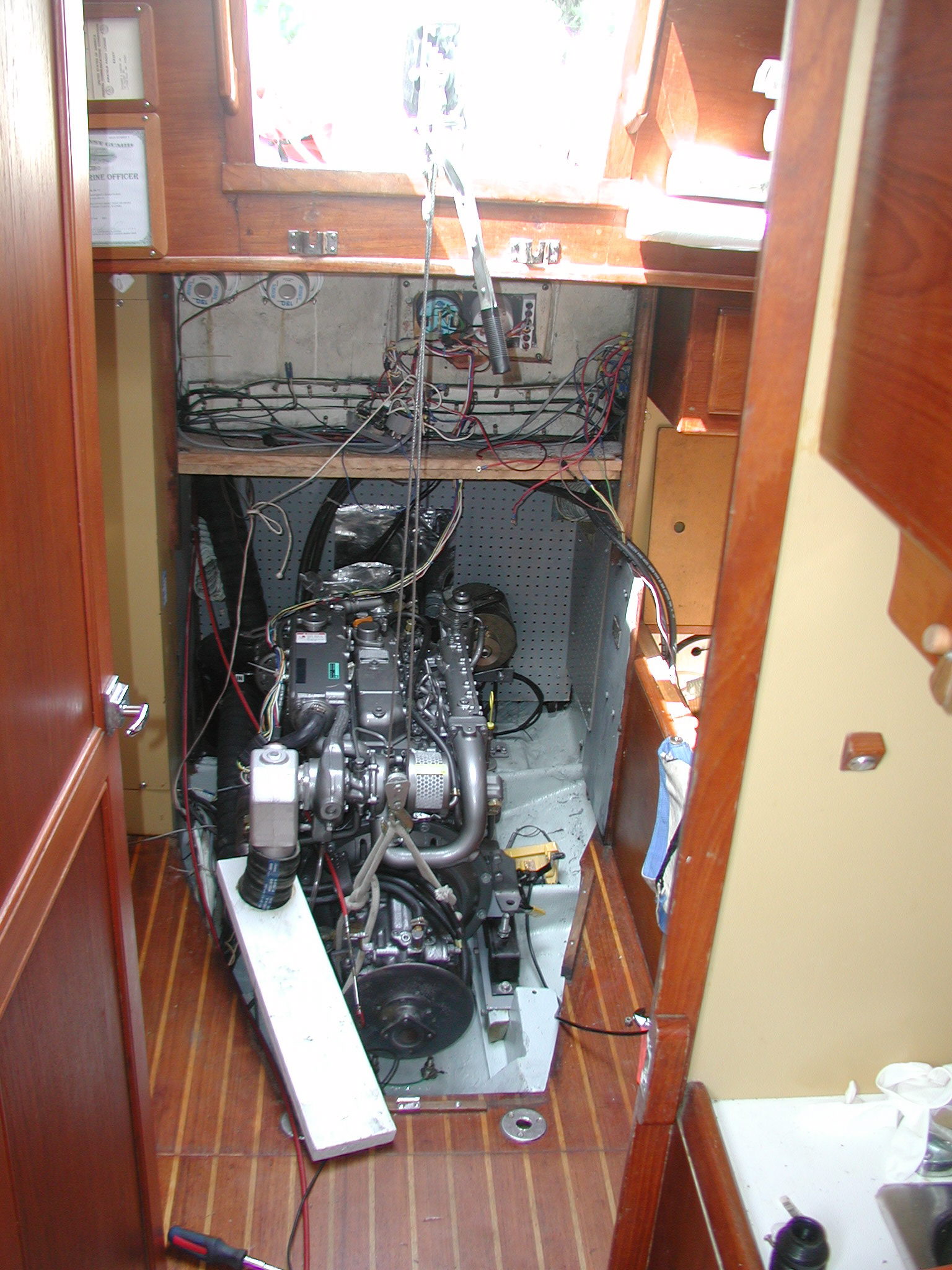
I see that you’ve received lots of replies to this one. I assume that you’ve broken the mounting feet that attach to the engine bed and not the mounting bracket that bolts to the engine. Using a cable-winch to lift the engine a bit may sound like a big deal, but it isn’t. Of course, it depends on which mount is broken. If it’s an aft mount, I’m not sure you can get in there with a winch to lift that end.
http://www.richardcarter.net/boat/pix/exhaustBend.JPGThere is probably no need to remove the drive shaft. You might try levering it first, but be careful not to break an flange on the engine. If you attempt to loosen the other motor mounts, you may break one or more free from the bushing. If you plan on keeping the same engine in there for some time, you may be better off just replacing all four. Before you make this decision, take a good look at access to the nuts under the engine bed flange. As mentioned several times in the past, Pearson did a poor job with the engine bed. It can be very difficult to get under the pan flange with a wrench to hold the nut on the bottom. I considered replacing the mounts on my old engine at one point in time, but decided it would be almost impossible to get the old ones out. When I repowered, I replaced the fiberglass flange with steel. The nuts are welded to the underside. This probably doesn’t help you out since I doubt you’ll be doing work to your pan just to replace a mount. You
may b
e able to cut and weld steel plates to fit under the fiberglass flange. With nuts welded to this, it may make it easier for you to reinstall the new engine mounts since you won’t have to hold the nuts.—
Rich Carter
Original message
<.. snip>Post generated from Pearson424 Forum using Mail2Forum
RichCarterParticipantI think it is 170gal. If I ever replace the side tanks, I may try for slightly larger tanks.
—
Rich Carter
Original message
<.. snip>Post generated from Pearson424 Forum using Mail2Forum
RichCarterParticipantI read a reference to using the BX. Its not as great a deal as it once was, but I’d sure like to be able to do so again. Does a Master’s license or TWIC card get me in?
—
Rich Carter
Original message
<.. snip>Post generated from Pearson424 Forum using Mail2Forum
RichCarterParticipantRodd
I don’t think it matters which side of the strut you mount the spurs. I must have been sitting on the starboard side when I mounted it.The zinc isn’t really up against the strut. There’s about a half-inch of space. I have it close so as to minimize drag. I hadn’t heard about any problems regarding restriction of water flow due to placement of the zinc, but I’ll investigate.
Regards
Rich Carter
Original message
<.. snip>Post generated from Pearson424 Forum using Mail2Forum
RichCarterParticipantPlease ignore the message below. I pasted a reply to a message regarding repowering to the wrong message and sent it out to the group by mistake.
—
Rich Carter
Original message
<.. snip>Post generated from Pearson424 Forum using Mail2Forum
RichCarterParticipantDoug
It would be odd that the direction of engine rotation would be wrong. Most gear reducing transmissions reverse the direction of rotation. Your local Yanmar dealer should be able to help settle this question.I love the prop. I see no loss of performance in forward and reverse works well too. Under sail, it folds with no problem. I see about 3/4 kt improvement in boat speed. My prop is exposed however. If yours is inside a skeg, you may see less benefit.
http://www.richardcarter.net/boat/pix/chainplate/prop2.JPGPlease keep me posted as to progress. I’m curious to see how it works out.
—
Rich Carter
Original message
<.. snip>Post generated from Pearson424 Forum using Mail2Forum
RichCarterParticipantAlan
We have a couple of acres, so there’s no problem with space. The house sits on what was once a farm. The land is as flat as a pancake. We have the boat shipped overland by a marine transportation company. I need to remove the mast of course and any antennae that stick up higher than the davits. Other than that, nothing else needs to be removed. The photo below shows the boat in storage. It was taken about 5 years ago. If you look closely, you can see my daughter on the radio tower. That’s as high as I would let her climb, about 30 feet.We added the deck on the side of the house just to make working on the boat easier. The stairs make climbing up and down much easier than a ladder, and the deck makes a good place to work. The underside of the deck is used as a carport. We have a 30 Amp outlet on the side of the house. Having it home allows us to work an hour or two in the evening without having to drive to a boat yard. Tools such as table-saw, drill press, etc are handy in the garage or can be carried up to the deck if there’s a lot of work to be done. I even ran a cable-TV connection out to the boat so I can hide there when levels of estrogen get too high in the house.
We live about 50 miles from the coast. It runs us about $600 shipping each way.
—
Rich Carter
Original message
<.. snip>Post generated from Pearson424 Forum using Mail2Forum
RichCarterParticipantIt’s a small square hole with a screen over it on the underside of the cooling jacket.
—
Rich Carter
Content-type: text/html
Comcast Webmail – An Error Has Occured ErrorError: The server timed out. Please try again.
Add Comcast Services
© Comcast Cable Communications, LLC. All rights reserved.
Privacy Statement
Terms of Service
To unsubscribe, e-mail:
For additional commands, e-mail:Post generated from Pearson424 Forum using Mail2Forum
RichCarterParticipantPat
On the question regarding pulling to starboard. I would have probably said no before repowering. At speeds below about 6.7 kts, it isn’t noticeable. If you took your hand off the wheel, the boat would turn to port, but I never really thought about it. With the added power from the new engine, I can cruise at higher speeds, so it becomes very noticeable. At full throttle, it will overpower the autopilot. There’s no reason to run that fast however. If I remember, I’ll take a photo of the prop when viewed from directly behind the rudder and post it so you can see how far the shaft is offset.—
Rich Carter
Original message
<.. snip>Post generated from Pearson424 Forum using Mail2Forum
RichCarterParticipantTor
I have a 4JH3-TE. The only difference between our engines is the turbo. I’ve heard threads from the group discussing fuel consumption. I’ve never been able to measure mine. I suppose that I could fill up before heading out for a long cruise, then fill-up when I get to where I’m going. Then compute fuel economy based on engine hours and fuel added. This assumes that I fill the tank to precisely the same level on both fillings. I don’t know how I could ever do this. It also assumes that I run at the same power setting for several hours. This is unlikely.To answer your question, I would expect that any two contemporary engines would give very similar fuel consumption figures when driving a 424 in similar conditions. Variations include the effects of prop efficiency, condition of the bottom paint, wind and sea conditions. I’ve always estimated 1 gal/hr. I think this is pretty close, but I could burn more than 4gal/hr if I ran it wide-open. I would also guess that fuel consumption goes up rapidly at speeds greater than about 6.7kts. I’ve based this on how much power the engine seems to need in order to drive the boat. I usually cruise at about 7.0 kts. With the price of fuel going north of $5/gal, I might back off a little.
This is definitely not a good time to own a power boat. Lets see 30 gal/hr at $5/gal = $150/hr. I don’t think so. Our dinghy even uses 3gal/hr. We put more fuel in the dinghy than the sailboat in a year.
—
Rich Carter
Original message
<.. snip>Post generated from Pearson424 Forum using Mail2Forum
RichCarterParticipantNo two 424’s are the same. I would expect that Pearson wouldn’t change this detail however since it takes quite a lot of work to get things designed properly. On my boat, the shaft is offcenter to starboard about 2 inches. This places the V-drive slightly offcenter to port and the skeg is canted slightly to starboard. If you remove the shaft, it pulls out just below and to starboard of the rudder skeg.
—
Rich Carter
Original message
<.. snip>Post generated from Pearson424 Forum using Mail2Forum
RichCarterParticipantThis is common. At full throttle, it takes two hands to hold the wheel. Pearson offset the propeller shaft to starboard to allow the shaft to be removed without having to cutoff the rudder skeg. When combined with the left-hand turn of the shaft, this makes the boat turn to starboard when under power. IMHO, Pearson should have offset the propeller to port instead to compensate for the prop rotation rather than enforce it.
—
Rich Carter
Original message
<.. snip>Post generated from Pearson424 Forum using Mail2Forum
RichCarterParticipantI’ve always used SAE-30 oil. This is the same stuff I used to put in my engine, but my new engine wants blended oil. In any case, 30 weight oil has always worked for me.
—
Rich CarterPost generated from Pearson424 Forum using Mail2Forum
-
AuthorPosts