Forum Replies Created
-
AuthorPosts
-
 RichCarterParticipant
Chris,
Pearson made the 424 in several rig configurations, changing dimensions from
year to year. Typically, the sloop is just a ketch without the mizzen
option. The cutter is typically a taller rig with the mast about 3 feet
farther aft.Regards
RichQuote:
Original Message
<.. snip>Post generated from Pearson424 Forum using Mail2Forum
RichCarterParticipantRodd,
Interesting. I know of several folks who regularly get good signal reports
from HF rigs mounted in cars, even as low as 80m. There is clearly no
contact with salt-water and have a meager ground plane. I think the 100sqft
figure was left over from the days when everyone had LORAN receivers
onboard. I still have mine in good working order. You need a big ground
plane for a good LORAN receiver.I still suggest getting as much ground as practical. More can’t hurt, and
you can never have too much. I have two bronze Dynaplates, one at the base
of the mast and a second close to the antenna tuner with copper foil running
between them. I’m spoiled though. I have good antennas at home and nothing
I do on the boat compares.Lower frequencies require bigger antennas and bigger ground-planes. I’ve
never been able to get my backstay to tune up on 80m and 160 is out of the
question. I don’t think it’s a ground-plane issue though. Just a simple
matter of the resonant length of the backstay. The SGC tuner doesn’t have
enough adjustment. I’ll play with it next season and see if I can put
something in there to help the SGC.If any of you hams out there want to play around with getting a Worked All
States certificate, I recommend checking out OMISS. Download their software
first and then log into one of their nets. They make it easy (almost).http://www.omiss.net/Facelift/
Regards
RichQuote:
Original Message
Post generated from Pearson424 Forum using Mail2Forum
RichCarterParticipantRodd
I’ve been using good quality sanitation hose for just about everything. The wire-reinforced rubber stuff has failed on me whereas the PVC sanitation hose seems to hold up.Regards
Rich
Original Message
Post generated from Pearson424 Forum using Mail2Forum
RichCarterParticipantI’ve been researching this since I’m preparing to head out on vacation and need to do something about wireless access. our vacation this year will be by camper, but we’ll have the same problems over land as we’ve had by boat. There are a lot of free access points, but they are rarely close enough to use with standard equipment. As noted earlier, I made my own long-range WiFi adapter a few years back, but I get marginal performance. I think the issue is low power from the generic USB adapter I used. I can salvage the omnidirectional antenna and replace the adapter.
The Ubiquity Bullet noted below looks perfect. it comes in various flavors with power output from 100ma to 1000ma. As far as I’ve been able to determine, it hooks up to your notebook using a standard RJ-45 network cable and hangs on your network much like any network device. It gets power from a Power Over Ethernet (POE) device. These connect to your ethernet between the computer and Bullet and send 12v power down the ethernet. These run about $40.
You need to attach a 2.4ghz omnidirectional antenna (with type-N connector) to the top of the bullet. I already have one but they are available. I haven’t found one for a reasonable price on the internet but I didn’t look very hard. I got mine at a ham radio flea-market. A directional antenna won’t work on a boat. Like most radio equipment, you get better performance with a good antenna than you do with increased power output. The antenna not only boosts your transmit power but also improves received signal strength.
The bullet appears on the network using a local IP address as described in the AirOs manual on the Ubiquity website. You open a browser and type in the IP address in the address box as described in their quickstart guide. The browser will show a set of menus that can be used to configure the adapter. This is the standard way a wireless router is setup, but you can use it to set it up as a client too.
http://ubnt.com/forum/showthread.php?t=21246I haven’t ordered anything yet. I’m still in research mode. The 1000mw bullet and POE run about $130.
Rich
Original Message
<.. snip>Post generated from Pearson424 Forum using Mail2Forum
RichCarterParticipantPhil
Interesting product. Seems to have a lower gain antenna than some other
products but cost effective and self-contained. How well does it work?Rich
Quote:
Original Message
<.. snip>Post generated from Pearson424 Forum using Mail2Forum
RichCarterParticipantI have a generic USB wifi adaper mounted on my rail in a waterproof box with
a 6db gain antenna. The thing works, but its range limited. The link below
looks great and the price is right. I wonder if they can package the think
with the higher gain antenna.Rich
Quote:
Original Message
<.. snip>Post generated from Pearson424 Forum using Mail2Forum
RichCarterParticipantDoor was made from the cutout section with solid-teak strips glued in to
match the existing doors.https://www.pearson424.org/gallery/rcarterinterior/P8180007
Regards
RichQuote:
Original Message
Post generated from Pearson424 Forum using Mail2Forum
RichCarterParticipantMother below should be motor.
Quote:
Original Message
Post generated from Pearson424 Forum using Mail2Forum
RichCarterParticipantLinus
If your inverter comes on automatically when your engine starts, just
running the 115v relay should work.Something doesn’t sound right. Your batteries are charging whenever you
have shore power or whenever your alternator is running. Running the
inverter to actuate the 115v relay should work, but I bet there’s a pressure
switch on your mother that’s supposed to close the solenoid switch too.
Maybe the switch is bad or there’s a loose wire.I have a copy of the Dashew’s book here on the shelf. The 12v system with
holding-plates is what they recommend. I would guess that a 1/2hp 12v motor
must be pretty big and probably a maintenance item. I’d rather have a 115v
motor and run it off an inverter, but AC motors can be hard to start off an
inverter.Rich
Quote:
Original Message
Post generated from Pearson424 Forum using Mail2Forum
RichCarterParticipantLets say that your alternator can put out 150A. One might think that you could put 150AH into your battery by running your engine for one hour. It doesn’t work that way. Your batteries won’t accept a charge at that rate. Even with the best smart regulator and a huge alternator you’ll be lucky to get an average of 50AH into your battery bank assuming that your bank is a typical size. So what can you do with that extra 100A that your alternator could provide that’s not going into your batteries? Run a 115v compressor through your inverter of course! That’s not going to take all of that extra alternator capacity but it will use some of it. I have an engine-driven system so that extra alternator capacity doesn’t go anywhere unless I run the microwave.
I would think that a 115v holding-plate system would have the best of both worlds. I’ve never had the opportunity to compare it with my system but on paper it should work. It might take more running time than an engine-driven system but would eliminate the rubber hoses and engine-mounted compressor which are maintenance items. It could also work off a generator or shore power.
My engine-driven system still consumes about 15A DC when running. This is what the water pump and clutch consume. I’d like to replace the water pump with something smaller. The original pump died many years ago and I replaced it with a big washdown pump. That’s all I could find.
Regards
Rich
Original Message
Post generated from Pearson424 Forum using Mail2Forum
RichCarterParticipantPete
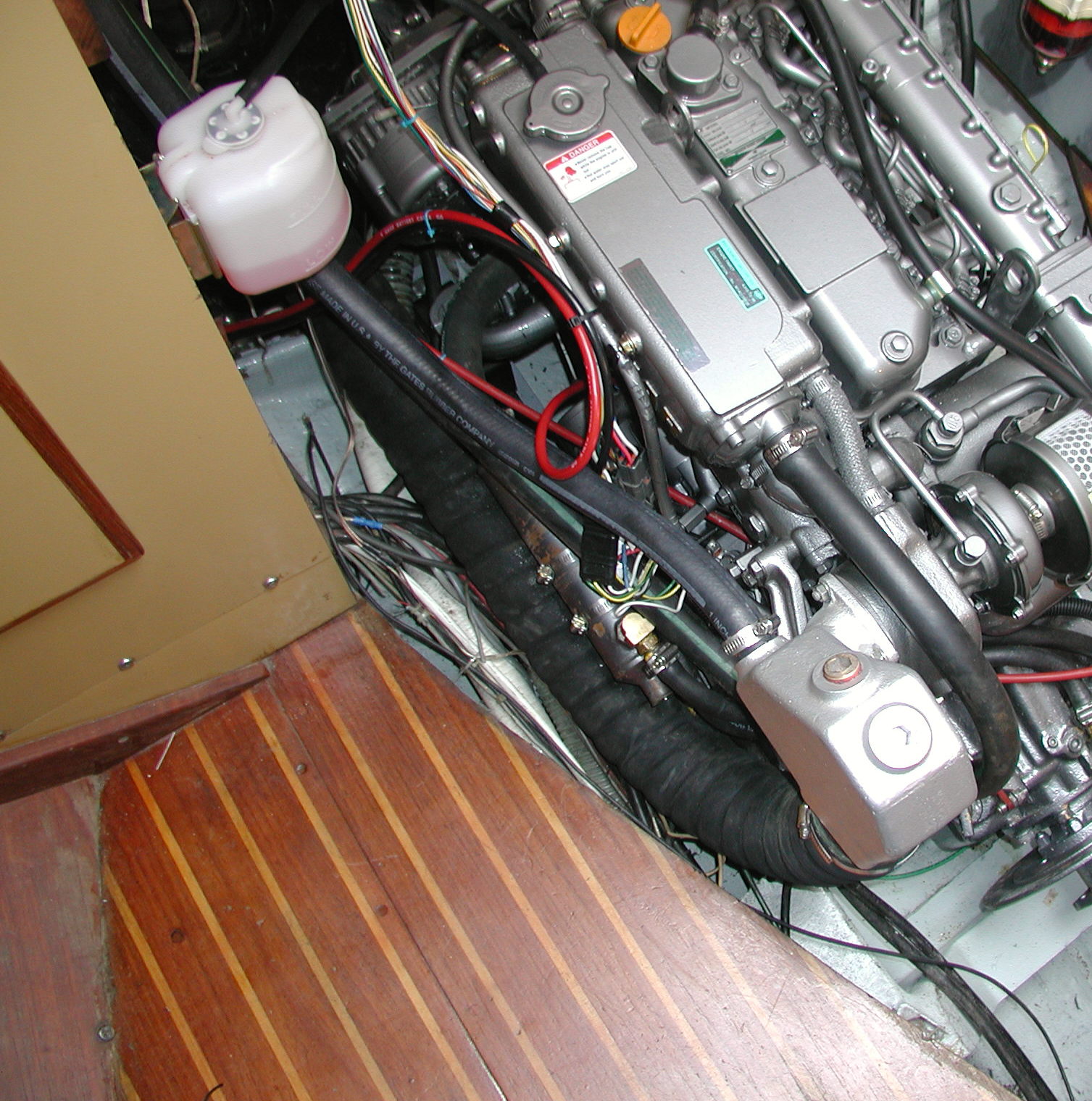
The photo is somewhat deceiving. Its downhill to the side of the engine bed and pretty much a straight-shot from there to the water lift. The hose was special “flexible” hose designed for bending in installations such as this. It was expensive, but I needed only a short piece to get to to the muffler, maybe 5 feet long. Even at that, it was pretty stiff to bend in place. I did quite a lot of headscratching to figure out how I might bend it in place. I came up with the idea of cutting a piece of wood with a hole in it to bend the pipe, then once it was all installed I could cut the wood piece out; worked like a charm. I had to lift the engine up a few inches to slide the pipe under the injection elbow. Then lower the engine to slip the nipple into the hose. It was probably 4 hours of bruised knuckles and swearing before I came up with a workable solution and an hour to actually get the hose cut and connected.The photos show the wrong hose clamps in place. I later learned that you must use special ($$) hose clamps for exhaust hose. The regular clamps aren’t strong enough to clamp down on the hose and make a good seal.
Rich
Original Message
<.. snip>Post generated from Pearson424 Forum using Mail2Forum
RichCarterParticipantTor,
It was tight in my installation too. I was able to shoe-horn everything in there, but since I had a clean slate I could move things wherever they fit. I did a lot of head-scratching over the installation.http://www.richardcarter.net/boat/pix/leftExhaust.JPG
Rich
Original Message
<.. snip>Post generated from Pearson424 Forum using Mail2Forum
RichCarterParticipantWhere the heck did they put your exhaust riser?
Rich
Original Message
<.. snip>Post generated from Pearson424 Forum using Mail2Forum
RichCarterParticipantAs I recall, I had trouble getting the splined-shaft re-inserted. The end
had an imprint in reverse of the part number for the joint. This indicated
that at one time the jack shaft was hitting the CV-joint. This not only
left the imprint on the shaft, but it flattened the end of the jack shaft.
The fix was to file the end of the spines on the shaft to taper them.It is probably not possible to move the splined shaft inside the jack shaft
housing. They rust together. Measure the amount that the shaft gets
inserted and verify that its within specs. Move the V-drive on the bed if
you must adjust.Rich
Quote:
Original Message
<.. snip>Post generated from Pearson424 Forum using Mail2Forum
RichCarterParticipantGee,
There’s not much to the starter solenoid. As I recall, there are two studs
on the solenoid. One goes to the key and the second one supplies power to
accessories. When you turn on the key, it turns power off to the
accessories. You would route this to your headlight switch in a car so that
you disconnect the headlamp load when starting your engine. Not all starter
solenoids have the accessory power stud. If you have one stud, it’s the
key. If you have two, use a test light to see which one powers the
accessories.Rich
Quote:
Original Message
<.. snip>Post generated from Pearson424 Forum using Mail2Forum
-
AuthorPosts