Forum Replies Created
-
AuthorPosts
-
Adam Silverstein
ParticipantHey Eric. Adam. From the Old Guard. You ever sell these?
ParticipantOnce you get the collar replaced, one method of sealing is a truck tire, cut to fit, clamped and folded over, with a Sunbrella cover matching your gorgeous sail covers around it to keep off the UV.
Then the question is mast chocks or Spartite?
ParticipantCaptain?
ParticipantI could use the Raw water Pump stuff. And maybe a spare thermostat. Lemme know if you still gots.
-adamParticipant?Adam SilversteinSilverstein & Saperstein, Attorneys(212) 233 4995 (direct)(646) 762 9857 (fax)Confidentiality Notice: The information contained in this message and any attachments is privileged and confidential information, intended only for the use of the individual or company named above. If the reader of this message is not the intended recipient, you must not review, retransmit, convert to hard copy, use or disseminate this e-mail message or any attachments. If you have received this e-mail in error, please immediately notify the sender by return e-mail or telephone.ParticipantIt’s just a wooden cradle. It comes apart.
Wrap the tank in moving blankets and stabilize it when you lift it bc it likes to swing, twist, fall and otherwise try to destroy the interior.
-adamParticipantI hate to say it, but given my experience carving epoxy out of the deep bilge, I would consider cutting the section out and reglassing it. Weigh the relative cost and difficulty of forming and laying the glass versus what will seem like a lifetime of chipping, carving, grinding etc. Note that it will significantly shorten your life.
Adam
On Jan 10, 2014, at 2:31 AM, “Page Two” wrote:
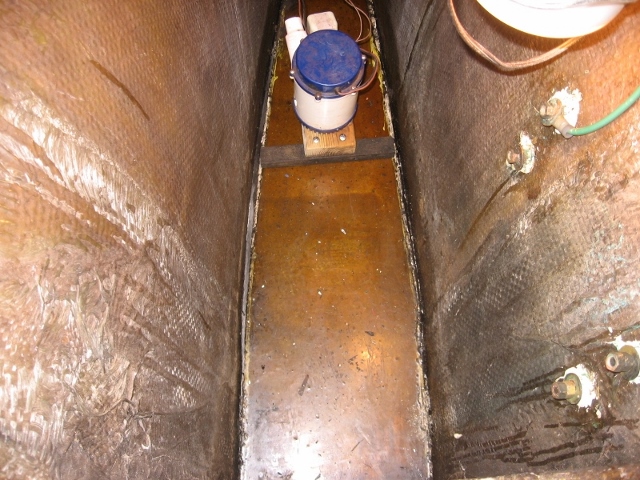
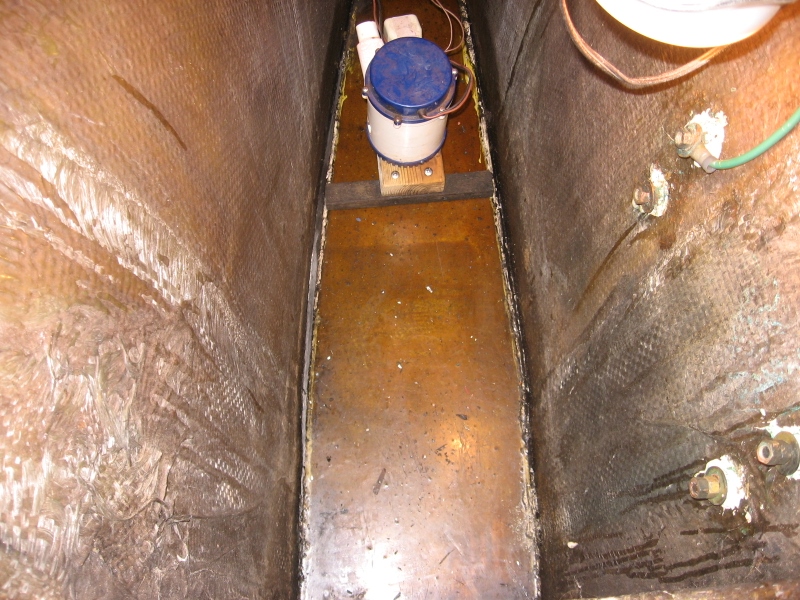
The PO filled the deepest part of the keel with, I believe he said epoxy. Now that I know the depth of the pour (I’ll explain in a minute) he did, I find it very hard to believe he even bought that much epoxy. The top had a nice sheen as epoxy or some kind of resin would leave. There was also a nice bead of 5200 all around the edge. It looked nice, it looked solid, easy to clean and vacuum out. Now it’s my nightmare.
I had told the yard owner and lift operator about not blocking the back end of the keel. I told them it was hollow and showed with my hands the approximate location of the lead. Figuring I had time to run out and get a quick breakfast in a warm restaurant as they were scrubbing the bottom (it was a record breaking cold day for Florida that morning) I took off sure I’d be back in time. Wrong.
I was told they were using a hammer to test the sound going aft and of course they were tapping down low about 8″ up from the bottom. Because of the filler (epoxy?) it sounded good and solid to them and they blocked it back about a third of the way into the void not feeling comfortable with blocking just up forward. When I got back, water was dripping (there was some in the bilge when I hauled) out the bottom. When I went inside and shined a light to my bilge…..the whole outer edge except at the keel had separated from the hull and got pushed up. The hull flexed out from the pressure. The next day they lifted me again and I placed the blocking from center of the lead edge and as far forward as possible and one small block about 6″ from the aft edge. The boat set down fine with the weight evenly distributed when the load was released from the straps, he said…”That felt better than yesterday” The hull inside the boat did not completely close back of course, so there is about a 1/4″ void all around for water to get in and under that filler. No good!
They ground the bottom and about a foot long crack showed up. They’ll take care of the bottom repair, as they should, but now I have the job of removing that monstrous hunk of whatever. I’ll add another layer or two of glass on the inside and leave well enough alone. I will not fill it. I’m going to leave that particular job for a few weeks and do thru-hulls, shaft, cutlass bearing first, then I’ll dig in the bottom. I’ll update my progress as I go.
I read the previous thread about this debate, to fill or not to fill. If you think about it, anything you poured, even if you clean the hull really good, will “pop” with that much pressure unless you physically attach it to the hull 360 degrees.
Ken
Ken and Vicky # 91……Writing a New Chapter Page by Page in an Old Book.Attachments:
https://www.pearson424.org/bb2forum/files/img_6413_800x600_640x480_198.jpg
https://www.pearson424.org/bb2forum/files/img_6413_800x600_194.jpg_______________________________________________
maillist mailing listhttps://pearson424.org/mailman/listinfo/maillist_pearson424.org
Post generated from Pearson424 Forum using Mail2Forum
ParticipantThe oil leak on the w60 comes standard (If you want a coolant leak you have to order it special). But say what you will; at 2000 rpm it makes the boat move and it veritably sips diesel.
Participant2″ oak block west/glassed into place with an aluminum step patterned after the original in 1/2″ Al, $150 clams from my local fabricator. The 2″ bottom of my mast is in my basement.
-adamParticipantThat makes me the holdout. And my iron genny Bessie one of the last W-60s. If you guys have any spares, etc, pls advise. I baby her, but I have a feeling I’ll need some parts. Exhaust manifold, for instance. Funky W-60 stuff.
-adamParticipantWalker Bay 10 with sailing kit on Kato davits. Was a 4-stroke Nissan 6hp, but that went swimming. Now a spare 4hp on the taffrail. The rib kit makes it stable for 4 adults. We have me, my ape-armed 110lb wife and 3 boys. And it’s getting tight. In a pinch, using the main halyard and a pair of lifting lines, it goes on the coach roof. My thought is it’s a lead pipe cinch to get ripped off (along with the davits) in really big weather.
ParticipantAs you correctly note, each hull is different. The encapsulated front of the keel is good for hitting stuff. The hollow keelbox is bad for blocking when hauled. You need to get a drill and drill through each section of your hull, noting the various thicknesses. (Please post results)
Adam Silverstein
On Aug 7, 2013, at 8:44 PM, “Page Two” wrote:
Has anyone found that there are variations in the hull thickness of the 424’s, and what have you found it to be in different locations if at all? Having a machinist background, I would appreciate estimates in 1/32″ if not 1/64″. Decimals is what I really love though!!! 🙂 I guess my question is based from being a wood boat guy and not really at all familiar with the methods of laying-up fiberglass back in the 80’s.
Is it thicker closer to the keel? Maybe less up forward where possibly a forward head would have thru-hulls?
I’m just curious, and want to visualize about the impact resistance of the hull.
Writing a New Chapter Page by Page in an Old Book.— m2f
_______________________________________________
maillist mailing listhttps://pearson424.org/mailman/listinfo/maillist_pearson424.org
Post generated from Pearson424 Forum using Mail2Forum
ParticipantRotella 30 weight. I put that s**t in everything.
ParticipantLength width and height of hood, length and width of slider. Thx!
ParticipantThx Bob. Gotta try “shop class as soulcraft!” As it turns out I just needed a bigger hammer. Plus there’s a Welshman holding all the parts hostage a la Westerbeke. Try $15 for an autozone quality grease nipple. (“Ah, but it’s METRIC!”)
-
AuthorPosts