Forum Replies Created
-
AuthorPosts
-
 john stevensonParticipant
Patrick,
I replaced my stuffing box with a PSS seal in 2001. No regrets, but I thought I had a leaking seal and had great difficulty getting a wrench on it. So I had the seal replaced by the boat yard when it was hauled. I had a similar seal on my previous boat for about 15 years.
They work fine, but I must admit they are in many ways a solution looking for a problem. The traditional stuffing box is hard to beat.
If I were to do it again, I probably would have stayed with the traditional stuffing box, but if I decided to go dripless it would probably be the TidesMarine product rather than the PSS. With the TM product you can fit a spare bellows on the shaft. No need to pull the shaft if the bellows fails.u, Dec 17, 2009 at 7:27 AM, Rick Dugger < ([email][/email])> wrote:
Patrick,
At the recommendation of the guys at our marina, who deal with some very large motor vessels, I replaced my traditional stuffing box with the SureSeal system from TidesMarine two seasons ago.
Easy Install. No regrets. No problems.http://www.tidesmarine.com/shaft-seals.html
Rick
EclipseOn Thu, Dec 17, 2009 at 6:48 AM, Patrick Walters < ([email][/email])> wrote:
I have a pretty traditional looking stuffing box and I'm curious if any of you have upgradedswapped out to a newer dripless type seal or if you have any particular comments about that.
I have the shaft out so at a minimum I'm going to repack it and I figure if it's worth upgrading now would be the time, but as with everything I'm interested in hearing the pros and cons from any who have gone before.
Thanks,
-p—-
s/v Deep Playa | Pearson 424 Hull #152 | http://www.DeepPlaya.com—
Regards,
John Stevenson
http://www.svsarah.comPost generated from Pearson424 Forum using Mail2Forum
john stevensonParticipantPatrick,
Take a look at the ChartWorld sight. I don't think it is for most of us. Looks to me they want to sell charts as a service not a product. You pay an annual fee for the charts. When you stop paying you lose the charts. I may have missed something, but that is what it looked like to me when I checked there sight a few years ago. Their service seemed to oriented to the fleet owners (cargo, charter, etc.) and crewed yachts that move all over the world.On Thu, Dec 10, 2009 at 6:41 PM, Patrick Walters < ([email][/email])> wrote:
Quote:Good suggestion. I am just getting started with that list. Mostly I threw it up there so I'd stop worrying about remembering things I wanted to look into.Coastal Explorer Chart support: http://www.rosepointnav.com/CoastalExplorer/NewCharts.htm also supports Navionics S-57 through Chartworld.
I'll add SOB (Australian company apparently) to my list, thanks!
I'm still torn with the ComputerChartplotter. Chartplotters like hardenede laptops are overpriced and quickly outdated. Might be better to just add a hardened touchscreen to the cockput and use multi-monitor and just have one unit tracking in the nav station.
Then you can also watch a movie in the cockpit. 😉 But I'm not sold on any one way yet. Just still looking.-p
—-
s/v Deep Playa | Pearson 424 Hull #152 | http://www.DeepPlaya.comFrom: “John Stevenson” < ([email][/email])>
Sent: Thursday, December 10, 2009 11:11 AM
To: ()
Subject: Re: Radar / ChartplotterPatrick,
That's a good start on evaluating the PC-based chart plotters. I wish I had used similar logic in my selection, I just backed into my choices based on price. For your evaluation I would also record what chart types each supports (e.g., ENC57, Raster, C-Map, Navionics, etc.). For example I really like the way Coast Explorer handles NOAA ENCs and knits them with the RNCs. However, CE does not support (or at least didn't the last time I checked) any of the proprietary formats (C-Map/Navionics). So it is a great product for coastal navigation around the US, but not much use if you head to Mexico or the Caribbean. For US coastal cruising I'll stick with Fugawi, although I really don't like the product. At least it will support Navionics for cruising outside of the US.
I recommend you take a look at Software On Board (SOB) from DigiBoat. It used to be the cheapest of the quality plotters ($70), I think it is now over $200. It only supports C-Map, so not the best solution for US coastal cruising, but it is one of the most robust products I've looked at. I much prefer it to Fugawi (which I have) or MaxSea and Nobeltec (which I don't). When I helped a few cruisers implement AIS while in Europe on both products I found them to be confusing and very counter-intuitive as well as vastly overpriced. I used SOB exclusively on my PC when cruising Europe and then last winter in the Bahamas (Navionics is worse than useless in the Bahamas).
One thing to keep in mind is how will you use the chart plotter while in the cockpit. That is why I ended up with both the Raymarine plotter (for the cockpit) and the PC plotter for serious navigation at the nav desk. Having the Raymarine plotter visible in the cockpit is great when making a landfall or entering a harbor. Off-shore it is just an entertainment tool for the night watch.Eric,
I have the Raymarine Pathfinder radar and C120 display using Navionics charts. I am satisfied enough with it (or short enough of expendable funds) to stick with it. Like Bob, if I were to make that purchase today it would likely be different – probably Furuno or Garmin. Raymarine seems to be concentrating on the mega-yacht business rather than we small-yacht cruisers. As others have pointed out, I will hold onto what I have until the newer technology improves.
With regard to paper charts. It's been years since I last pulled out one of my paper charts and they are now way out of date. The next time I go to a SSCA GAM I'll probably dump them. I think you are on the right track to practice navigation using conventional charts, but very few cruisers I know use them underway. The common practice ( or at least my practice) is to collect a few charts of specific harbors you intend to visit or represent harbors of refuge and up-to-date cruising guides along with the electronic charts. New paper charts now are just too expensive.On Thu, Dec 10, 2009 at 1:22 PM, Patrick Walters < ([email][/email])> wrote:
Quote:According to Ben Ellison (http://www.Panbo.com) the pulse systems to indeed have less range and because of that less of an ability to view weather but they do have HUGE gains in <1NM resolution. If you're mostly concerned about navigating fog. I think the pulse system is for you. If you're main concern is offshore I'd either go with a traditional RADAR or wait a year and see if the pulse systems improve their range.I'm starting to do some reasearch on PC based Navigation Software and I'm looking at which ones have RADAR overlay. You might want to check that list out.
http://www.deepplaya.com/wiki/Navigation-Software.ashx-p
—-
s/v Deep Playa | Pearson 424 Hull #152 | http://www.DeepPlaya.comFrom: ()
Sent: Thursday, December 10, 2009 9:55 AM
To: ()
Subject: Re: Radar / ChartplotterEric
I originally purchased a RADAR unit in 1986 for my 424. It may be the same model as you presently have. I replaced it a few years back with a JRC color RADAR/chartplotter and never regretted it. JRC makes the guts of many of the RADAR units such as Raymarine but are less costly. JRC stopped selling under their own name. Distributors put them out on clearance. I bought mine for about $1300. This is the only distributor I could find with a websearch. They want too much money for what they have in stock. If you keep your eye out you might find one for a little over a grand.
http://www.boatersworld.com/bm/RadarAutopilots/JRC/316300565.htmlI mounted my display in the cockpit. I put a teak mounting panel on the binnacle guard. I'm not entirely pleased with the instrument mount and may redo it, but it works.
http://www.richardcarter.net/Cockpit.htmlI too cruise in the Northeast. I really like having the RADAR/chartplotter at the wheel. I have a laptop below that runs Nobletec which does a lot better job as a chartplotter but running below to navigate is a pain. I rarely need the RADAR but use it when its convenient. Power consumption isn't a big deal. The FURUNO used a lot more power. If your budget is limited, go for an inexpenive unit and skip the bells and whistles. Most collisions occur at closer distances than 12 miles. Having a long-range and powerful RADAR is of limited use. My Furuno was a better RADAR unit but it sucked down the watts and I had to mount it below. The JRC works just fine and doesn't run down my batteries.
Don't forget to budget for charts. The c-map cartridges are expensive.
Regards
Rich
Original Message
<.. snip>Post generated from Pearson424 Forum using Mail2Forum
john stevensonParticipantThe key to avoiding a voltage drop to the instruments and causing them to reset is to isolate the starting and house batteries. If you have one of those Off-1-2-Both switches get rid of it (unless it is just controlling one bank of batteries).
On Thu, Dec 10, 2009 at 5:39 PM, Robert Fine wrote:
Hi Lee,
My C80 is almost three now – I wouldn't worry if it's been working alright. Here's what I have to say about the failure rate, though. Raymarines seem to be far more susceptible to voltage spikes/variations then Garmins – also, if they are not installed correctly with 12v going to the Seatalk bus, they will behave very badly, indeed. I know from personal experience.
But once up and running, they're perfectly fine. The one issue I'd check is that you can start the engine without resetting the C120. If you can, Bob's your uncle.
I've seen far too many vessels whose electrical system seems to be somewhat substandard (not ours, of course) and that takes a huge toll on the electronics.
It could also be that as of today, there are twice as many Raymarines installed than Garmins – Up until a couple of years ago, Garmins were not outstanding at all. They have come a LONG way, and are currently eating Raymarine's something or other, I forget what, but it's something Raymarine doesn't want eaten. I'm not changing now, but if I were…
I still keep the current paper chart in the cockpit and keep track of where I am on it…
Bob
On Thu, Dec 10, 2009 at 5:23 PM, Lee Yonkers wrote:
A friend if mine, who works for Sea tow and picks up and delivers the pilots here in Brunswick told me last week that he pulls about four times as many Raymarine users as he does Garmin users. Not empirical data but interesting non the less. I have a two year old C120 and now I am a little concerned.
Lee
—
Bob Fine
s/v Pelican
Pearson 424 Hull #8
http://thesailinglife.blogspot.com
Follow me at: http://www.tinyurl.com/WhereIsBobFine—
Regards,
John Stevenson
http://www.svsarah.comPost generated from Pearson424 Forum using Mail2Forum
john stevensonParticipantBob, Quent,
I experienced what Quent described as two problems. One is the lockup, for that I had to replace the RS120. I got a RS125 as a replacement because the Raymarine Tech thought my RS120 was still under warranty – Their screw-up, but they stood by it. If it weren't for that Raymarine was will to let me pound sand, and I would have gone with an NMEA GPS, such as Garmin.
The satellite issue is really a C/E-series software problem rather than a RS120 probem. I don't think it actually affected the position reported by the display. It appears Raymarine hard-coded the display to look for the WAAS satellites to display the “SD” (satellite differential) status. I don't believe it really changed the position accuracy, the GPS took care of processing the WAAS corrections. The only fix provided by Raymarine was to the C/E-series software. I assume it is now hard-coded to the new WAAS satellites.
I have found no problems with the RS125.On Thu, Dec 10, 2009 at 3:39 PM, quent wrote:
Hi Bob-
Apparently a software problem affecting its ability to work with the newer satellites. John knows the technical details.
It manifested at least on my system as a chartplotter screen that just stopped moving, no alarm or other warning. A bit nasty approaching Memory Rock eastbound after dark. Luckily, it was only one of several GPSs aboard. I think the later Raymarine GPS units are OK, but fool me once…!
Raymarine graciously offered to sell me a new current model for $300 or so. I decided to get a Garmin 17 for $100. The Garmin works just fine.
Quent—
Regards,
John Stevenson
http://www.svsarah.comPost generated from Pearson424 Forum using Mail2Forum
john stevensonParticipantEric,
I don't think there is a significant difference in quality between the two products (at least for halyards). If you have access to a Port Supply account the NE ropes will probably be much cheaper through WM.On Thu, Dec 10, 2009 at 1:59 PM, Eric Lorentzon < ([email][/email])> wrote:
I just cant spend boat units fast enough…… Also have to replace Main and Jib halyard.
Any preferences out there for Sampson vs New England Ropes?
Eric—
Regards,
John Stevenson
http://www.svsarah.comPost generated from Pearson424 Forum using Mail2Forum
john stevensonParticipantPatrick,
That's a good start on evaluating the PC-based chart plotters. I wish I had used similar logic in my selection, I just backed into my choices based on price. For your evaluation I would also record what chart types each supports (e.g., ENC57, Raster, C-Map, Navionics, etc.). For example I really like the way Coast Explorer handles NOAA ENCs and knits them with the RNCs. However, CE does not support (or at least didn't the last time I checked) any of the proprietary formats (C-Map/Navionics). So it is a great product for coastal navigation around the US, but not much use if you head to Mexico or the Caribbean. For US coastal cruising I'll stick with Fugawi, although I really don't like the product. At least it will support Navionics for cruising outside of the US.
I recommend you take a look at Software On Board (SOB) from DigiBoat. It used to be the cheapest of the quality plotters ($70), I think it is now over $200. It only supports C-Map, so not the best solution for US coastal cruising, but it is one of the most robust products I've looked at. I much prefer it to Fugawi (which I have) or MaxSea and Nobeltec (which I don't). When I helped a few cruisers implement AIS while in Europe on both products I found them to be confusing and very counter-intuitive as well as vastly overpriced. I used SOB exclusively on my PC when cruising Europe and then last winter in the Bahamas (Navionics is worse than useless in the Bahamas).
One thing to keep in mind is how will you use the chart plotter while in the cockpit. That is why I ended up with both the Raymarine plotter (for the cockpit) and the PC plotter for serious navigation at the nav desk. Having the Raymarine plotter visible in the cockpit is great when making a landfall or entering a harbor. Off-shore it is just an entertainment tool for the night watch.Eric,
I have the Raymarine Pathfinder radar and C120 display using Navionics charts. I am satisfied enough with it (or short enough of expendable funds) to stick with it. Like Bob, if I were to make that purchase today it would likely be different – probably Furuno or Garmin. Raymarine seems to be concentrating on the mega-yacht business rather than we small-yacht cruisers. As others have pointed out, I will hold onto what I have until the newer technology improves.
With regard to paper charts. It's been years since I last pulled out one of my paper charts and they are now way out of date. The next time I go to a SSCA GAM I'll probably dump them. I think you are on the right track to practice navigation using conventional charts, but very few cruisers I know use them underway. The common practice ( or at least my practice) is to collect a few charts of specific harbors you intend to visit or represent harbors of refuge and up-to-date cruising guides along with the electronic charts. New paper charts now are just too expensive.On Thu, Dec 10, 2009 at 1:22 PM, Patrick Walters wrote:
Quote:According to Ben Ellison (http://www.Panbo.com) the pulse systems to indeed have less range and because of that less of an ability to view weather but they do have HUGE gains in <1NM resolution. If you're mostly concerned about navigating fog. I think the pulse system is for you. If you're main concern is offshore I'd either go with a traditional RADAR or wait a year and see if the pulse systems improve their range.I'm starting to do some reasearch on PC based Navigation Software and I'm looking at which ones have RADAR overlay. You might want to check that list out.
http://www.deepplaya.com/wiki/Navigation-Software.ashx-p
—-
s/v Deep Playa | Pearson 424 Hull #152 | http://www.DeepPlaya.comFrom: ()
Sent: Thursday, December 10, 2009 9:55 AM
To: ()
Subject: Re: Radar / ChartplotterEric
I originally purchased a RADAR unit in 1986 for my 424. It may be the same model as you presently have. I replaced it a few years back with a JRC color RADAR/chartplotter and never regretted it. JRC makes the guts of many of the RADAR units such as Raymarine but are less costly. JRC stopped selling under their own name. Distributors put them out on clearance. I bought mine for about $1300. This is the only distributor I could find with a websearch. They want too much money for what they have in stock. If you keep your eye out you might find one for a little over a grand.
http://www.boatersworld.com/bm/RadarAutopilots/JRC/316300565.htmlI mounted my display in the cockpit. I put a teak mounting panel on the binnacle guard. I'm not entirely pleased with the instrument mount and may redo it, but it works.
http://www.richardcarter.net/Cockpit.htmlI too cruise in the Northeast. I really like having the RADAR/chartplotter at the wheel. I have a laptop below that runs Nobletec which does a lot better job as a chartplotter but running below to navigate is a pain. I rarely need the RADAR but use it when its convenient. Power consumption isn't a big deal. The FURUNO used a lot more power. If your budget is limited, go for an inexpenive unit and skip the bells and whistles. Most collisions occur at closer distances than 12 miles. Having a long-range and powerful RADAR is of limited use. My Furuno was a better RADAR unit but it sucked down the watts and I had to mount it below. The JRC works just fine and doesn't run down my batteries.
Don't forget to budget for charts. The c-map cartridges are expensive.
Regards
Rich
Original Message
Post generated from Pearson424 Forum using Mail2Forum
john stevensonParticipantPete,
I just did a quick check on the USCG site and I can find no specification for the height of the stern light. The only position requirement is that it be as close to the stern as practical. Since Tor does not believe the light on the stern rail is practical because of the glare it provides to the helmsperson, it would seem his choice of location conforms. Of course it should conform to the requirement for a visible arc of 135 deg, which the original stern light installed by Pearson on the transom does not.
I've considered using bow and stern anchor lights as Tor does, but I am concerned the idiots driving through the anchorage at night might think it was two boats and decide to go between them.On Tue, Dec 1, 2009 at 7:49 PM, Pete Dubler < ([email][/email])> wrote:
Quote:Tor,Check the COLREGS. I am pretty sure that there is a height limit and requirement regarding proximity to the transom for the stern light.
Pete
Silver Heels wrote:
Quote:*But before I go I can't resist adding this. I installed an LED Aqua Signal masthead tri-color + anchor light. Sealed the old hull running lights and mounted a single port/starboard light beneath an athwartships board just inboard of the forward end of the bow pulpit. I put my new “deck level” stern light _on the mizzen masthead_, rather than on the stern rail. In my experience, the typical rail-mounted stern light often creates a giant blind spot by reflecting and refracting off the mist and exhaust just astern of the boat underway, especially when motoring. As a result, the watch keeper cannot see astern, which is not a good thing. *** *Regarding deck level anchor light blind spots, I hang one Home Depot garden-variety solar lamp at the end of the mizzen boom, and another one from the two genoa sheets pulled together above the foredeck. At least one of the lights is visible from every angle of approach, and the pair make my boat easy for me to find at night in a crowded harbor. *
** *Have fun!*
** *Tor
~~~~~~~~~~~~~~~~~~~~~~~
Silver Heels, P-424 #17
http://www.SilverHeels.us
~~~~~~~~~~~~~~~~~~*
Original Message
*<.. snip>Post generated from Pearson424 Forum using Mail2Forum
john stevensonParticipant+1 to Bob's comments about having both masthead and deck level lights. Those Perko bow lights Pearson installed in the hull will eventually need to be replaced. I replaced mine 3 years ago with an Aqua Signal dual light fixture on the bow rail and sealed the holes for the old lights with a thin sheet of Lexan (it was what I had). I was amazed that the original lights lasted as long as they did. They were not sealed from the elements. I guess the PO never did any hard sailing.
I replaced my masthead lights with DrLEDs last year. The previous incandescent bulbs drew around 2A. I don't know what the LEDs draw. The masthead anchor light is very dim, but visible. I learned from one winter anchoring in the Bahamas it is better to have the anchor light near deck level. The guys zooming around the harbor at night in their big RIBs or center console fishing boats are not looking up, if they're looking at all. So my anchor light now is an LED cluster from Bebi Electronics hung on the end of the boom. In spite of the fact Bebi is located in Fiji, their prices and shipping costs are very competitive.
I left the deck level lights with incandescent bulbs as they are normally only on when motoring.On Mon, Nov 30, 2009 at 2:17 PM, Robert Fine < ([email][/email])> wrote:
Quote:Which array is that? How much was it, and how many watts and where did you get it?Bob
On Mon, Nov 30, 2009 at 1:26 PM, Thatcher A. Stone < ([email][/email])> wrote:
Quote:I have the Hella Nav LED’s installed on the rail as recently highlighted in either a SAIL or CRUISING WORLD article. Slowly I have replaced all my lights aboard to LED or mostly LED. When I say mostly I mean some of the multiple cabin lights are still incandescent.
At the same time I put in a large photovoltaic panel for electricity. Just forward of the main companionway.
Very pleased with the results: I am able to run the nav lights in the PM and by 11 AM the drain is charged.
<.. snip>Post generated from Pearson424 Forum using Mail2Forum
john stevensonParticipantPete,
If it just won't go under the beam you can try what my installer did – bevel the aft edge of the beam with a sawsall.On Fri, Nov 27, 2009 at 10:39 PM, Pete Dubler < ([email][/email])> wrote:
Ahhhh wise one! Now that makes sense. I will have to try that first tomorrow!
Thanks,
Pete
Chuck Ruble wrote:
Pete, it shouldn't need to be removed to get the tank out. I couldn't get the fill fitting off the tank so I cut it with a hack saw. The tank will drop down and slide under the brace when the stern end is tipped up. It took a few tries but it slid right out. I was looking at doing the same thing but was fed this same information and it turned out to be right.
Chuck
On Fri, Nov 27, 2009 at 9:12 PM, Pete Dubler < ([email][/email])
Rich, (anyone else in the Pearson group can also comment on this.
Thanks!)I am in the middle of pulling my fuel tank and wanted to ask you
for some clarification of how you removed the front support piece
to create vertical clearance.Did you just pass a sawzall under the carriage horizontally to cut
our the screws? Or how exactly did you do it?Thanks,
Pete
To unsubscribe, e-mail: ()
For additional commands, e-mail: ()
To unsubscribe, e-mail: ()
For additional commands, e-mail: ()—
Regards,
John Stevenson
http://www.svsarah.comPost generated from Pearson424 Forum using Mail2Forum
john stevensonParticipantEric,
I haven't used my Asym much in the last few years, but that won't stop me from offering advice.I assume the tang you refer is the one common to all of the 424 mast I've seen, and it is intended for a Spinnaker halyard. Any good quality swivel block for the size halyard you choose should work fine. It just needs to articulate 90 degress, port and starboard and 90 degrees from vertical to horizontal. I would recommend 7/16″ low stretch rope for the halyard (e.g., StaSet-X).
The one thing you will need to rig is a down haul for the tack of the Spinnaker. I use an ATN tacker that fits around the furled Genoa. I rig a downhaul from the tacker to a block on the stem fitting and the down haul is led back to the cockpit. I keep the down haul permanently rigged on the side of the cabin trunk to eliminate one job during the setup.
Others have attached the down haul directly to the tack of the sail and fly it free. The ATN tacker keeps the tack close to the forestay, and (IMO) makes it easier to trim and control.However you rig the tack of the sail, make sure you can release it quickly. The fastest way to depower an over-powered spinnaker is to release the tack. That makes the ATN snuffer useless, but you can bring the sail onto the deck by releasing the halyard and hauling in on the sheet.
The one thing I haven't finished on my setup is the ability to snuff the spinnaker from the cockpit when I'm single-handing.
John
On Mon, Nov 23, 2009 at 10:19 AM, Eric Lorentzon < ([email][/email])> wrote:
Hi Folks,
I just added a symmetrical spinnaker to my sail inventory and am looking for suggestions on rigging. My current plan is to use an ATN Tacker and a sock for sail management.
I am not sure what to do at the mast head. There is the tange off the forward port side that I figured would hold the block for the spinnaker halyard. The sail is a 160% for the boat measuring 45'10″ with a 24″ girth.
Any reccomendations on Halyard block and lines would be greatly appreicated.
We are out of the water with masts down (re-wire planed too.)
Eric
SV Navasana—
Regards,
John Stevenson
http://www.svsarah.comPost generated from Pearson424 Forum using Mail2Forum
john stevensonParticipantOh to be young, thin and flexible again
On Mon, Nov 23, 2009 at 8:28 AM, quent < ([email][/email])> wrote:
In the wine celler!
Q—
Regards,
John Stevenson
http://www.svsarah.comPost generated from Pearson424 Forum using Mail2Forum
john stevensonParticipantTor,
I purchased a couple of 2' sections of track from Garhauer at the boat show for my stay sail track. I don't remember what they charged me, but it must have not been much for me not to remember it.http://www.svsarah.com/Sarah/ewSolentStayFinish.html
Thanks for the suggestion of rope caulk. More than few ducks must have drowned here in New Bern over the last week, but not a drop through the track fasteners.
On Wed, Nov 18, 2009 at 11:54 AM, Robert Fine < ([email][/email])> wrote:
Hi Tor,
It's a standard track that you can get from Defenders, West Marine (maybe), or many other places. Sometimes, the track is in two pieces – the top part for the slide and the piece under it. I've seen them both ways. But the 1-1/4″ track is pretty standard.
Bob
—
Bob Fine
s/v Pelican
Pearson 424 Hull #8
http://thesailinglife.blogspot.com
Follow me at: http://www.tinyurl.com/WhereIsBobFine—
Regards,
John Stevenson
http://www.svsarah.comPost generated from Pearson424 Forum using Mail2Forum
john stevensonParticipantPete,
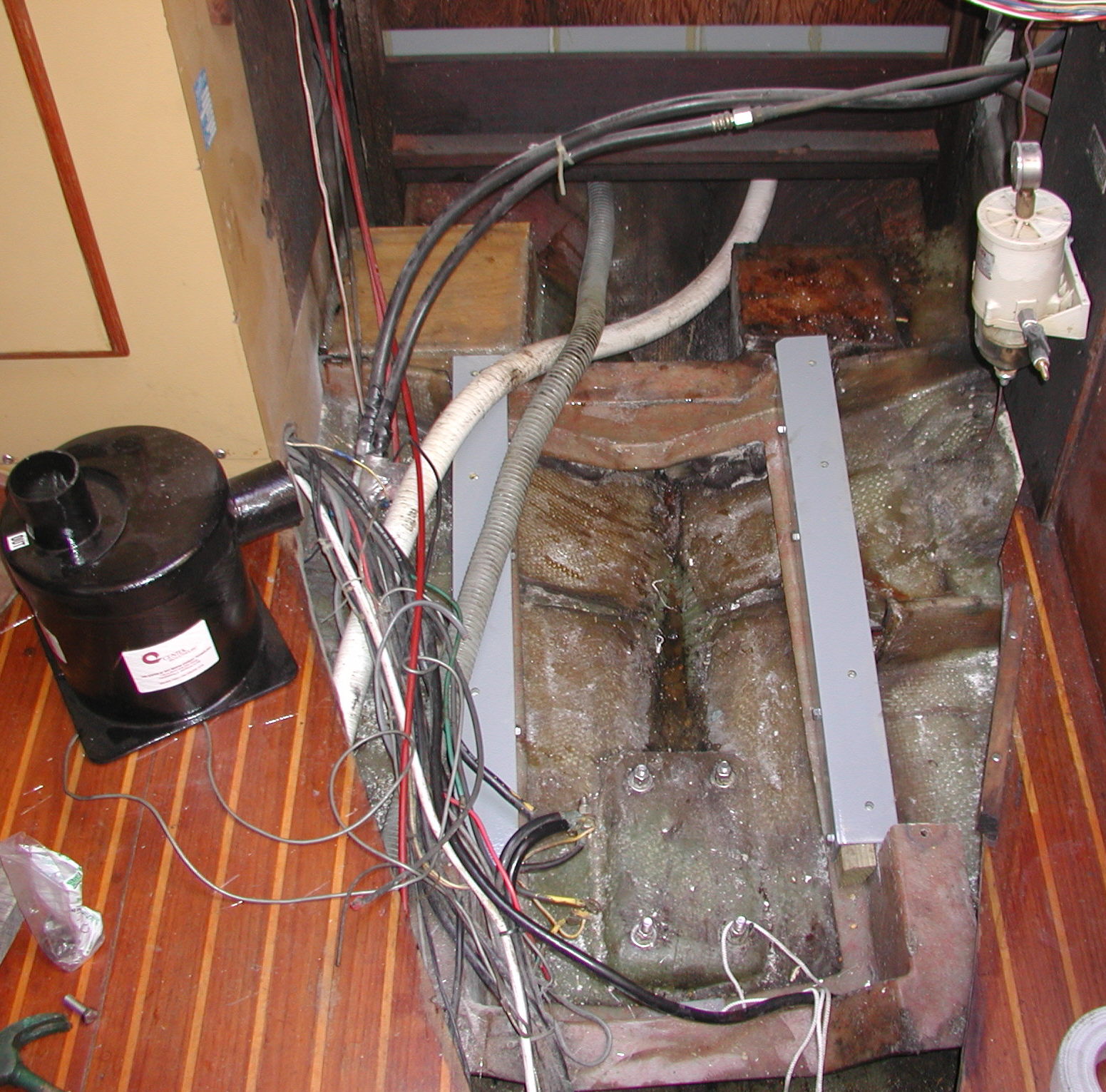
I thought one of my repower pictures would show the water passage under the engine pan, but I guess I never took a picture from behind the engine pan. As Rich said it is not a big passage. I know when the Westerbecke was pulled there was a ton of dirt and debris around the passage. Water still got through, but it did pool up behind the engine pan.
If you say you don't have a passage under the pan, have you checked to see if it is just covered by 25 years of crud? It really shouldn't accumulate water under the engine unless you have a gusher, but then your pan may not be anything like the one I had on hull #2. Again I never had water accumulate under the engine (other than engine liquids) with a persistent rudder post leak for over a year before the engine pan was re-built and re-glassed.On Mon, Nov 16, 2009 at 10:03 AM, Pete Dubler < ([email][/email])> wrote:
Quote:Speaking of British engines… did you know that British engines STILL don't have microprocessors (computers) controlling them? Reason: the Brits have not yet figured out how to make a computer leak oil…And yes, I have been studying your photos. Thanks.
I am thinking of fashioning a separate drip pan for the engine and allowing the aft water to pass under it to the main bilge. I like to hat the oilsorb sheet stay dry (from water and oil…) To me that is the sign of a well-maintained engine space.
Pete
Quote:I've since cut out most of my engine pan as part of a repower. The engine pan was open at the bottom and had a place for water to pool behind the strut mount and behind the pan. Here's a photo of the old pan with modified side pieces to mount my new engine.http://www.richardcarter.net/boat/pix/engPan.JPG
There was a small space under the aft section of the pan that allowed some water to escape under the engine, but a lot of water still pooled under there. After taking this photo I cut out the back of the pan. It simply isn't needed and interfered with the new engine.
After repowering, I still put oilsorb sheets under the engine but they come out mostly clean at the end of the season. The old W60 was a nice engine but like most British engines it leaked like a sieve.
Regards
Rich
Original Message
<.. snip>Post generated from Pearson424 Forum using Mail2Forum
john stevensonParticipantChris Parker, http://www.mwxc.com/
On Sun, Nov 15, 2009 at 1:03 PM, Silver Heels < ([email][/email])> wrote:
Quote:Or Chris Richardson…
Original Message
<.. snip>Post generated from Pearson424 Forum using Mail2Forum
john stevensonParticipantPete,
That's not the way my bilge works. Water from aft of the engine compartment flows under the containment pan under the engine into the main bilge. I know because I have had a persistent leak from the rudder post stuffing box. Tightening or re-packing the stuffing box will dry things up for a year or so, but then the leaks start again. Currently my bilge pump comes on every 24-36 hours for about 30 seconds. The only water that collects in the under engine containment pan is that from dealing with the engine water and coolant hoses.On Sat, Nov 14, 2009 at 6:09 PM, Pete Dubler < ([email][/email])> wrote:
Just got my engine out today. I am a bit confused about the bilge arrangement under the engine. Any water from the bilge aft of the engine ends up in the separate bilge under the engine. Shouldn't this water flow forward to the main bilge and shouldn't there be a separate pan under the engine to catch engine fluid leaks and contain them (separate from water from the aft of the boat?
Thanks,
Pete
To unsubscribe, e-mail: ()
For additional commands, e-mail: ()—
Regards,
John Stevenson
http://www.svsarah.comPost generated from Pearson424 Forum using Mail2Forum
-
AuthorPosts