Forum Replies Created
-
AuthorPosts
-
 RichCarterParticipant
I hate having the tank vent into the bilge. If you overfill your water tank it dumps water into the bilge.
A buddy of mine has a Vagabond. His tank vents to tubes inside his stanchions. A vent tube is run inside the stanchion and through the deck. The vent hose is attached to the underside of the tube. I always thought this was clever. If he overfills his water tank it spills on his deck and can be seen when you fill the tank. I have to keep my ear close to the tank fill and listen for the sound of the water. Its easy to miss the sound the water makes when the tank reaches full. I’ve thought of doing something similar to some of my stanchions. I guess its on the list of things that aren’t really broken but should be fixed some day. I rarely work on that list.
Regards
Rich
Original Message
Post generated from Pearson424 Forum using Mail2Forum
RichCarterParticipantI don’t think Pearson put a rub strake at the bow. I know mine didn’t come with one. I cut some half-round SS stock and attached it to the outside of the toe-rail just below and forward of the chock. You’re right about the snubber cutting the toe rail. By the time I did this there was some damage by the mooring pennant. My guess is that a previous owner might have done something similar but may have not properly located the thing.
I have similar stock below the midship cleat. Pearson didn’t install these cleats either but most folks have added a cleat either as a car on the genny track or like me as a permanent fixture just forward of the track. I’m not sure its safe to tie-up to a dock without something better than a stanchion to tie to. If you wander around any marina, its surprising to see how many folks don’t have a midship cleat however.
I haven’t yet bothered to put a rub strake beneath the stern cleats.
For folks who haven’t bothered to add one of these, here’s a link. Its cheaper to buy your own stock and cut it to fit but this is convenient.
http://www.defender.com/product.jsp?path=-1|10391|321176|757306&id=1280205One of my good friends got caught in New Bedford harbor last year when hurricane Irene hit the northeast. He stayed on a strong transient mooring with his wife. Both pieces of the dual pennant he was tied to chafed through. I’ll bet both pennant lines were the same length. This left the boat only tied with a spare dock line that he had rigged-up as a third pennant. By the time the storm passed, most of the third line was gone too. It had chafed where he looped the eye through the mooring ring; no thimble. I saw what was left of it, just a small piece of the inner core was holding his boat. They did OK but got struck by several other boats that broke free. His wife somehow broke her wrist however. I think she slipped on the wet deck trying to fend-off a passing boat. I carry a spare 1″ pennant with me when I cruise. Its got a proper thimble spliced with shackle and chafing gear; cheap insurance.
Attaching the snubber to a pad-eye at the bow might have some advantages. You’d have to make sure its pretty well backed. I’ll guess that you have to leave it attached and somehow drape it back over the bow and stow the lose end somehow. Otherwise you’d have to be a contortionist to hook the thing up when you want to use it.
Regards
Rich
BlackSheep #47
Original Message
Post generated from Pearson424 Forum using Mail2Forum
RichCarterParticipantAnchoring is like religion. At the risk of starting a religious argument…
The next time you use an equal length double-line snubber or double line pennant in a blow, visit the bow and watch the lines for a while. You’ll see the lines alternately take up and release their load as the boat swings in the wind. This will cause the lines to rub against their chock. They will also heat up. In an extreme situation, the inside of the line can get hot enough to melt.
You could use polyester line instead of nylon. This line has less stretch and therefore doesn’t rub against the chock as much when under alternating loads. It also doesn’t heat up as much. It transfers shock loads more directly to your deck hardware however. I had a chock fail once on me. It can happen.
I prefer nylon. It has some stretch and therefore doesn’t transmit shock loads to the deck hardware. On my mooring I use dual nylon pennants of unequal length. One takes all the load and the second is there for backup. In a real blow, I’ll run a third pennant of even longer length back to one of the main winches. I use either 7/8″ or 1″. When anchored, I use a single snubber, 5/8″ with a chain hook. This works for me.
Anchor rollers aren’t designed for high loads. They are fine for a couple of hundred pounds but not for a couple of thousand pounds. In particular, they don’t do well when the load is from the side. If your boat swings in a blow, loads will not be from directly ahead all the time. This isn’t good for your roller. Most have no way to prevent a snubber from slipping out of the roller. It just seems to be the wrong tool for the job.
I’m curious about your experience putting the line over the roller instead of the chock to stop the boat from swinging in a breeze. I can’t think of any reason it would make much difference. The roller is offcenter as is the chock. The difference is but a few inches. In any case, the boat doesn’t swing because the attachment point is offcenter. You can reduce the tendency to swing at anchor with an anchor riding sail. I can’t think of any other practical way to do this with but one anchor.
Regards
Rich
Original Message
Post generated from Pearson424 Forum using Mail2Forum
RichCarterParticipantYes, my comment about height would be applicable even if I had a mizzen. You want it high enough so you don’t radiate crew on the deck but I see no point in getting it up much higher. 15 feet or more should do. When I first bought a RADAR unit many years ago, I thought that a unit with longer range would be desirable. After getting more experience I find that its more important to have a unit that works well at close range. I usually switch among the closest range settings and rarely use the 3-mile or longer ranges. I might use the longer ranges for navigation or weather observation. At close range in calm seas I can see seagulls and lobsta floats out to about 1/8 mile.
If I had a ketch, I’d probably put it on the mizzen. I might be concerned about interference with targets directly ahead. Its most important that the unit work well directly ahead since that’s where you’re going. I’ve no experience with how much interference the main mast might cause in a ketch mounting configuration however. I can say that the mast behind where the radome is mounted causes a shadow. I get reduced sensitivity directly aft caused by interference from the main mast.
Last year we had a rendezvous at Point Judith. It was pea-soup fog headed to and again returning from the event. On the way in I could barely see the bow from the helm. Point Judith is difficult to navigate in poor visibility. The channel is narrow and winding. On the way in I saw a large echo on the RADAR display. It was clearly a very large vessel headed toward me. When you get a large target, it paints across the screen making it impossible to determine target heading. I nudged over to the extreme right side of the channel per my chartplotter and slowed down to headway speed, sounding my horn as required. Out of the fog came the bow of the Block Island Ferry no more than two boat-lengths ahead. This is a big steel boat. His bow must have been almost even with the top of my mast. I wonder if he ever saw me. It scared the pants off me. I made a sharp turn to starboard and barely avoided a collision. I think the ferry was on the wrong side of the channel but who’s to argue? No, a vessel over 20m in a channel doesn’t have to right-of-way over a sailing or power driven vessel under 20m. We are required to not impede the larger vessel but this doesn’t give them right-of-way. He’s supposed to stay on his side of the channel. I don’t think I would have even attempted to enter the harbor if I hadn’t had RADAR but its not a perfect solution.
Regards
Rich
Original Message
Post generated from Pearson424 Forum using Mail2Forum
RichCarterParticipantMine is on the main mast just above the spreaders. I don’t personally think long range is important so getting it up high shouldn’t be a priority. I usually use shorter ranges. Most collisions occur within less than a half mile 😉
Rich
Original Message
Post generated from Pearson424 Forum using Mail2Forum
RichCarterParticipantMy 424 broke free from here mooring back in 1982 and washed up on the rocks at the head of Marblehead harbor; bad chain. Her keel was ripped off and she sank on the beach. She was salvaged by a local boatyard and restored. I bought her in 1986 and have owned her since. There are some minor cosmetic issues but she has proven to be a solid boat. It is possible to restore one of these boats even with catastrophic damage. The hull value of these old girls doesn’t justify the kind of repair that was done on my boat when she was almost new however.
Rich
BlackSheep
Original Message
Post generated from Pearson424 Forum using Mail2Forum
RichCarterParticipantPatrick
One could assume that the problem is either on the seawater side or the freshwater side of your cooling system. Have you noticed good flow out of your exhaust system when running? With my old W60 engine, I could tell if I had blockage just by listening to the sound of the exhaust. The white smoke is probably steam. This sounds like a problem with the raw water side. I assume you’ve cleaned your raw-water strainer.With the engine running hot, try dumping some hot water in the sink. If the engine temperature drops slightly, its your seawater cooling. You’ll probably find steam and hot water venting from your water heater into the bilge too.
Assuming that its your seawater flow, its a matter of finding the blockage. It could be anywhere in your seawater lines. It could be seaweed blocking the through-hull or corrosion in your V-drive cooling jacket or the water injection elbow. It might even be a water pump vane that broke off and is lodged in a hose. Start pulling hoses and work your way back to the seawater pump to see where the flow stops.
I wouldn’t bother to pull the thermostat. If you have to open the thing, just replace it. Bring the old one to an auto-parts store and have them match it.
Hope this helps
Regards
Rich
Original Message
Post generated from Pearson424 Forum using Mail2Forum
RichCarterParticipantAs I recall, the fuel sender is accessible by climbing into the starboard locker and reaching across the top of the tank. Access is also available by removing the sight glass. Between the two access places, its not a big deal to service or replace the fuel-gauge.
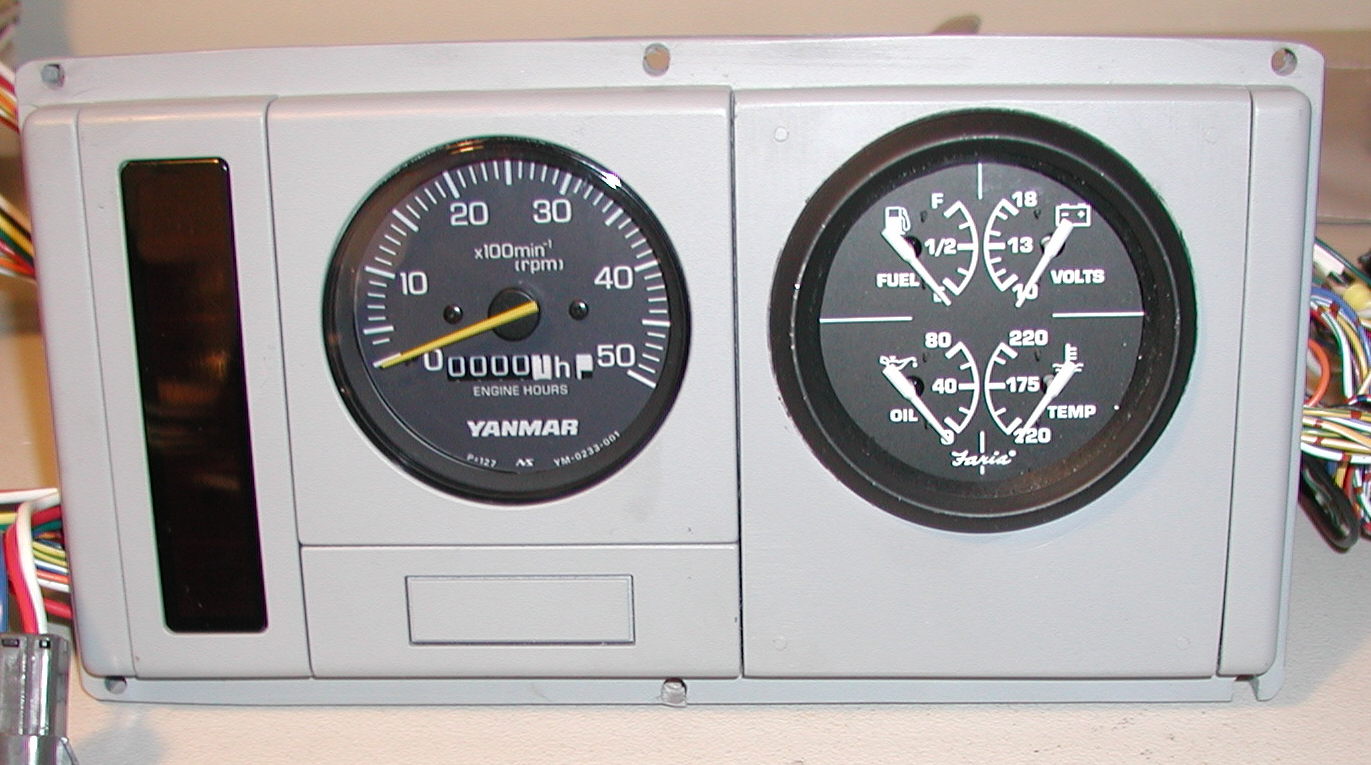
As long as the tank baffles don’t interfere with the swing-arm on the sender, replacement of the mechanical gauge should be straightforward. Of course, you need a convenient place to mount the gauge. I was repowering at the the time so I build the replacement instrument panel with an integral fuel gauge.
When I replaced my tank, the fabricator installed the baffles such that the swing-arm wouldn’t work. We ended up replacing the swing-arm sender with a vertical type sender. A custom length had to be made since the replacement tank was an inch or so shorter than the original. All works now.
http://www.richardcarter.net/boat/pix/instruments.JPGRich
Original Message
Post generated from Pearson424 Forum using Mail2Forum
RichCarterParticipantDan,
I can’t think of a stupider way to measure fuel level. I used to get down on my hands and knees to observe the gauge. I think there is a drop-in transducer that will drive most remote gauges. You might need one that slides up-and-down rather than one that is hinged. When I replaced my tank and engine, I had a remote gauge added to the instrument panel.About the old peep hole, I thought the glass was held in with a snap-ring. These would help.
http://www.harborfreight.com/snap-ring-pliers-with-interchangeable-heads-3316.htmlRich
Original Message
Post generated from Pearson424 Forum using Mail2Forum
RichCarterParticipantI used refrigerator rollers, available at most home goods stores. I lifted the engine using a cable winch and slid 2×6 boards under the engine mounts. Used the rollers to slide the engine forward and out of the way. Under no circumstances shuold the engine sit on its pan.
Rich
Original Message
Post generated from Pearson424 Forum using Mail2Forum
RichCarterParticipantRodd
There are less expensive alternatives to Balmar. Give me a call if you want to consider alternatives.The tack will work correctly as long as the pulley is the same size.
Rich
Original Message
Post generated from Pearson424 Forum using Mail2Forum
RichCarterParticipantMy rigger strongly advices that I remove the winches from my mast and reinstall with a layer of Mylar under them. The bronze winches can corrode the mast. I haven’t done this yet since the thought of removing the winches after this many years isn’t appealing. I think I’ll have to heat the fasteners and risk damaging the mast wiring harness. This has been on my to-do list for 20 years now.
Rich
Original Message
Post generated from Pearson424 Forum using Mail2Forum
RichCarterParticipantI’ve painted mine with interlux one-part polyurethane paint several times over the 26 years I’ve owned her. I just tape-off the hardware and rigging and brush on a coat. I first wash the mast and give it a light sanding with a sanding sponge pad followed by a wipe-down with denatured alcohol. The paint looks very good for about 3 years after which it dulls. I repaint every five years or so. I can do the entire job in an afternoon, assuming the mast is down. The process leaves brush strokes, but you can’t see them unless you get closer than about 10 feet. If someone wants to criticize the job, they are welcome to grab a brush and help out. Most of the mast is more than 10 feet above deck so nobody ever gets to see that anyway. I try to be as careful as possible with the bottom part of the mast, particularly the section that shows in the cabin. Some folks have a cloth wrap around their mast in the cabin which would hide the most important section. Most of the bottom section above deck is usually hidden by the mainsail cover. There’s only about 3-feet that shows.
You can get very carried away with this job, spending thousands for a sprayed-on finish. I can’t see the point since it won’t last longer than about 7 years even with awlgrip.
Regards
Rich
BlackSheep #47
Original Message
Post generated from Pearson424 Forum using Mail2Forum
RichCarterParticipantThe issue is that the existing shore power plug on the boat will have live power on it. If someone gets their hand in there they could get injured.
Rich
Original Message
Post generated from Pearson424 Forum using Mail2Forum
RichCarterParticipantMy boat has a 30A 115v make receptacle for shore power. If you add a second receptacle and feed power through it, the make plug will be hot. This is a bad idea and must violate some codes.
I made a 15A shore power adapter cord many years ago using a cheap extension cord and a plug purchased at the hardware store. It wasn’t expensive. You don’t really need a fancy marine plug for this.
I use an EU-2000 on my boat. It works pretty well.
Rich
Original Message
Post generated from Pearson424 Forum using Mail2Forum
-
AuthorPosts